

What Is the Torque Release Technique — And Why Do We Use It?
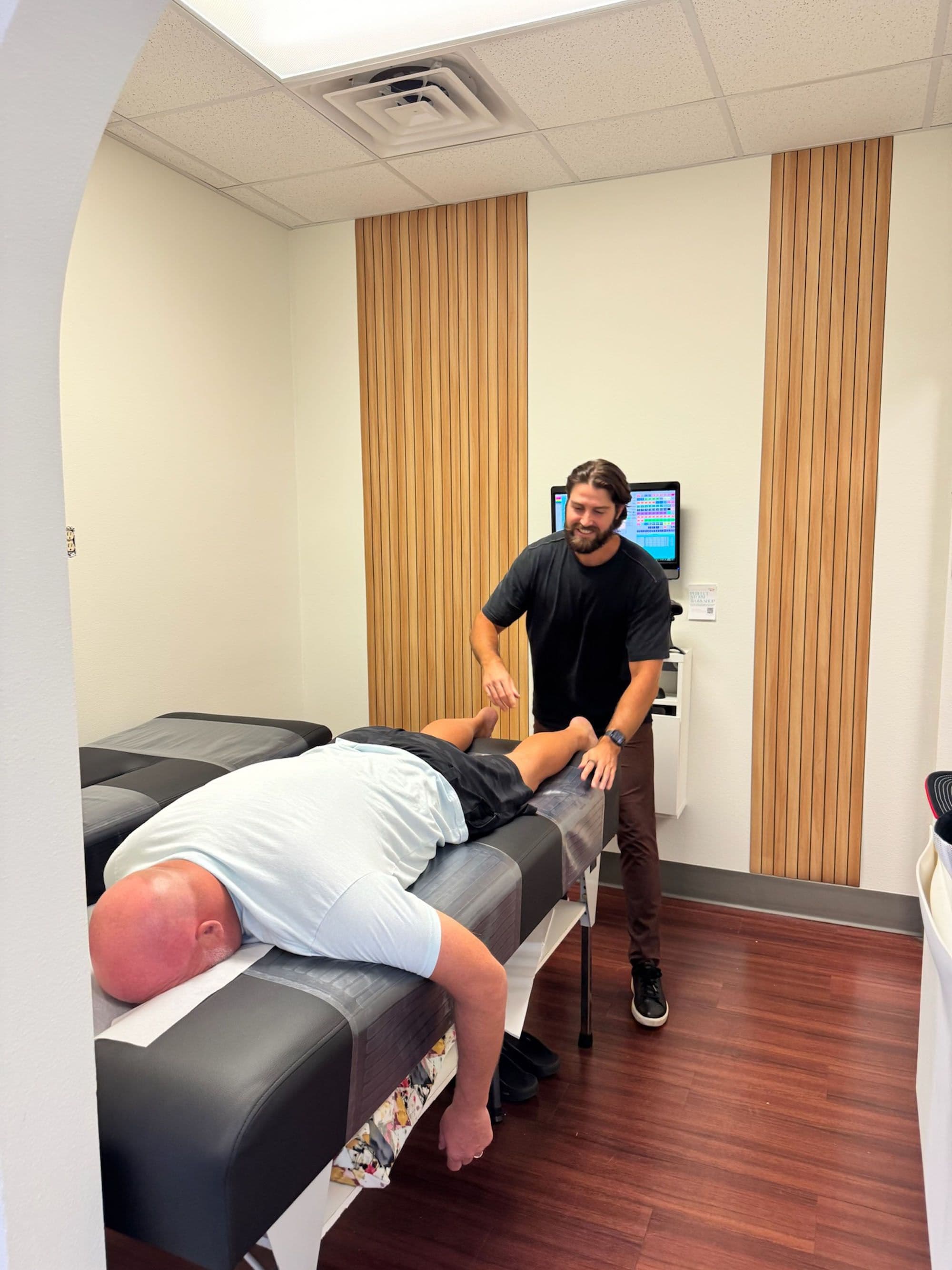
If you have ever been to a traditional chiropractor, you probably have a very specific image of what an adjustment looks like. You lie on a table, the doctor twists your body, and something pops loudly. For a lot of people, that image alone is enough to keep them from ever walking through a chiropractor's door. It sounds aggressive. It sounds scary. And honestly, if you are older, have osteoporosis, have a fused spine, or you are thinking about bringing your newborn in, it probably should sound scary. The traditional high-velocity, low-amplitude adjustment — the one that produces the familiar crack — is not the right fit for every body.
A completely different approach
Torque Release Technique is completely different. At The Roots Health Centers in Lakewood Ranch, it is the only method we use. No twisting. No cracking. No popping. Instead, a small handheld spring-loaded instrument called the Integrator delivers a precise, low-force adjustment at exactly the right spot, at exactly the right angle, with exactly the right amount of pressure. It is gentle enough for a newborn in their first week of life and precise enough to resolve decades of chronic nervous system dysfunction in an adult.
The technique was developed in the 1990s by Dr. Jay Holder, who combined insights from several existing chiropractic methods into a unified, research-backed protocol. Holder drew heavily on the work of Dr. Larry Webster — the same pioneer who developed the Webster Technique for prenatal care — and on the Thompson, Toggle Recoil, and Van Rumpt methods. The result is an evidence-based approach validated in published clinical research and a NIH-funded randomized controlled trial.
What actually happens during an adjustment
After the nerve scan and postural evaluation, you lie face down on a specially designed drop-piece table. Dr. Logan Swaim palpates your spine and lower extremities looking for subtle differences in leg length that indicate where your nervous system is holding tension. That tension pattern — called a subluxation — is what the adjustment is designed to release.
The Integrator itself is worth understanding. It is a spring-loaded tool that:
- Fires at a fraction of the force of a manual adjustment
- Moves about three times faster than a human hand can
- Delivers the impulse along the exact vector the spine needs
- Completes the adjustment in seconds — most people describe it as a gentle tap
Speed means the adjustment happens faster than your muscles can tense up in anticipation, which is why there is no guarding, no bracing, and no discomfort. Many patients fall asleep on the table.
It is the nervous system, not the bone
This is where Torque Release differs most from traditional chiropractic. Traditional techniques focus on spinal joints that are fixated. Torque Release focuses on the nervous system itself. The goal is not to move a bone back into place. It is to reduce the tension the nervous system is holding in specific segments of the spine, which in turn allows the body to self-correct.
That distinction matters because the nervous system drives every other function in your body:
- Heart rate and blood pressure
- Digestion and gut motility
- Immune response
- Sleep quality
- Hormone regulation
- Muscle tone and breathing
All of it is coordinated by nerve signals traveling through the spine. That is why patients who come in for back pain often report that their sleep improves, their digestion normalizes, and they feel calmer overall. The adjustment was never just about the pain.
It is gentle enough for a newborn in their first week of life and precise enough to resolve decades of chronic nervous system dysfunction in an adult.
Safety and who it is right for
Torque Release is safe for populations where traditional HVLA adjustments are often inappropriate:
- Elderly patients with osteoporosis
- Patients with rheumatoid arthritis, spinal fusion hardware, or severe disc degeneration
- Pregnant women, including late-pregnancy positioning concerns
- Newborns and pediatric patients
- Anyone with anxiety about traditional cracking
There are almost no contraindications. Because the force is so low and so precise, it does not aggravate disc bulges, it does not stress fragile bones, and it does not produce cavitation. The handful of situations where we would not adjust at all — active infection at the site, unstable fracture, certain acute spinal cord conditions — apply to any form of chiropractic and would be caught during the initial exam.
The research behind it
A randomized controlled trial published in Molecular Psychiatry and funded by NIH examined Torque Release in addiction recovery patients and found significant improvements in anxiety, depression, and overall well-being compared to controls. Additional studies have documented improvements in:
- Heart rate variability (a measure of autonomic nervous system function)
- Quality of life metrics
- Objective nerve scan outcomes
For a chiropractic technique, that level of peer-reviewed validation is rare and worth noting.
Objective measurements every visit
Every Torque Release visit is guided by objective data. Before the first adjustment, we run a neurological evaluation that measures three things:
- Surface EMG — muscle tension patterns along the spine
- Thermal scanning — autonomic nervous system function
- Heart rate variability — your body's ability to adapt to stress
Those scans tell us exactly where the nervous system is holding tension and give us a baseline to measure against. We re-scan periodically throughout your care so you can see real, measurable change — not just a subjective report of how you feel. It is one of the main reasons patients stick with care long-term. The progress is visible. You can see patient case studies for examples of how this plays out over a full care plan.
Who benefits
Honestly, almost everyone. Babies benefit because their tiny nervous systems are uniquely responsive. Pregnant moms benefit because it addresses the pelvic and spinal shifts of pregnancy without any abdominal pressure. Athletes benefit because the precision matches the demands they put on their bodies. Elderly patients benefit because the low force is safe for fragile structures. Chronic pain patients benefit because the nervous system component is often the missing piece in their care.
The population we most commonly see benefit dramatically is the one that has tried traditional chiropractic, not gotten results, and given up on the profession entirely.
If you are curious what it feels like, the best way to find out is to come in for an evaluation. The first visit includes a full history, a neurological evaluation, and a consultation with Dr. Logan Swaim to review the findings and map out a plan. The goal is not to crack backs. It is to clear the nervous system so your body can do what it was designed to do. Book a complimentary consultation or call (941) 877-1507.
Services Related to This Post

Keep Reading
Related articles
What Is Corrective Chiropractic — And How Is It Different?
Most chiropractors focus on temporary symptom relief. Corrective chiropractic is designed to make lasting structural changes — here's how.
Read articleWhat Is a Chiropractic Neurological Evaluation? How We Measure Your Nervous System
A chiropractic neurological evaluation uses surface EMG, thermal scanning, and heart rate variability to show how your nervous system is actually functioning — not just where it hurts. Here is what each measurement means and why it matters for your care.
Read articleFamily Chiropractic: What Happens When Your Whole Family Gets Adjusted
Most families discover chiropractic through one person. Then something shifts — and suddenly everyone's under care. Here's why that keeps happening at Little Roots.
Read article