

Can Chiropractic Care Help With Stress and Anxiety? The Nervous-System Connection

If you've searched "can chiropractic help with anxiety" during another wired, sleepless week, you're onto something more physiological than it might seem. Chronic stress doesn't stay in your head — it shows up as tight shoulders, shallow breathing, a racing heart, and a nervous system that has trouble downshifting out of high alert. At The Roots Health Centers, we look at stress and anxiety through that lens: not just as a mood, but as a nervous-system state your body carries around all day. Chiropractic care isn't a replacement for therapy or medical care for anxiety, but for many people it's a genuinely useful piece of the picture. Here's how, and where the honest limits are.
Your nervous system runs the stress response
Your nervous system has two main gears: sympathetic (fight-or-flight, geared for a threat) and parasympathetic (rest-and-digest, geared for recovery). Under short bursts of real stress, that system works exactly as designed — it revs up, handles the moment, then settles back down. The trouble starts when the "settle back down" part stops happening reliably, and your body spends weeks or months idling in a low-grade alert state instead of a calm one.
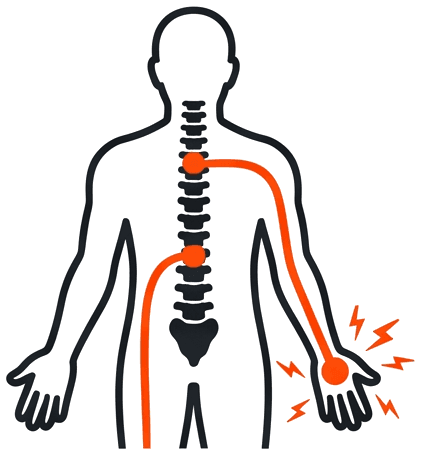
The spine houses the pathway your brain and body use to communicate constantly, in both directions. When that communication is running smoothly, your nervous system has an easier time reading the room correctly — recognizing when a stressor has actually passed instead of staying braced for one that never comes. That's the piece chiropractic care is built to support: helping your nervous system regulate itself, not managing your emotions directly.
What fight-or-flight feels like, day to day
Chronic sympathetic activation rarely announces itself as "anxiety" first. More often it shows up as the small stuff: shoulders that won't drop, a jaw you catch yourself clenching, shallow chest breathing instead of deeper belly breathing, trouble falling or staying asleep, a stomach that's touchy for no clear reason, and a general sense of being keyed up without an obvious cause. If any of that sounds familiar alongside racing thoughts or a short fuse, you're describing a nervous system stuck in a stress pattern — which is also frequently tangled up with chronic fatigue, since a body that never fully rests rarely wakes up rested either. This kind of ongoing tension is exactly what our anxiety and stress page walks through in more detail.
Where chiropractic care fits in
Our approach starts with a full neurological evaluation — not a guess, an actual look at how your nervous system is functioning, plus any necessary X-rays where they're clinically indicated. From there, chiropractic care at The Roots uses the Torque Release Technique, a gentle, low-force adjustment method, to help address areas of the spine that may be interfering with normal nervous-system communication.
The goal isn't to "crack the stress out of you" — that's not how any of this works, and we won't pretend otherwise. The goal is to help remove interference so your nervous system can do what it's already built to do: shift out of alert mode once the actual threat has passed. For some patients, that shows up as sleeping a little easier or feeling less wound-up by the end of the week. Each person and case is different, so we take a personalized approach based on what your body is showing us, rather than promising a specific outcome or timeline.
The research, in plain terms
Here's the mechanism in plain language, without overselling it. Your spine is packed with mechanoreceptors — sensory nerve endings that constantly feed information to your brain about position, movement, and tension. Areas of restricted movement in the spine can alter that information stream, which may influence how your nervous system interprets and responds to stress signals. Some research has also looked at chiropractic care's relationship to heart-rate variability, a marker connected to how well your body shifts between stress and recovery states.
We're careful not to overstate this. Chiropractic care supports nervous-system regulation — it doesn't rewire brain chemistry, and it isn't a clinical treatment for a diagnosed anxiety disorder. It's one input into a nervous system that responds to many inputs.
It's not a replacement for therapy or medical care
We want to be straightforward about this, because it matters. If you're managing a diagnosed anxiety disorder, panic attacks, or a mental health condition affecting your daily life, please keep working with a therapist, counselor, or physician — that care is essential, and chiropractic care is not a substitute for it. What we offer sits alongside that care, not instead of it. Plenty of our patients see us for nervous-system support in addition to therapy or medical treatment, and that combination is a reasonable one to bring up with your other providers.
Chronic stress and chronic pain often travel together
Stress and pain tend to feed each other. A nervous system stuck in alert mode often holds more muscle tension, which can make existing pain feel louder, and persistent pain is itself a stressor that keeps the nervous system on edge. We see this pattern clearly in fibromyalgia, where our nervous-system-first approach looks at widespread pain and nervous-system regulation as connected, not separate, problems. If chronic pain has been part of your stress picture, that overlap is worth mentioning at your consultation.
Simple nervous-system habits alongside care
A few things support the same goal outside our office, and cost nothing to try: slow nasal breathing for a few minutes when you notice your shoulders creeping up, consistent sleep and wake times rather than a shifting schedule, regular movement — walking counts — and time outdoors, which Lakewood Ranch makes easy most of the year. None of these are a fix on their own. Together with care, they're the kind of small, boring habits that actually add up.
What a first visit looks like
Your first visit includes a consultation, a full neurological evaluation, any necessary X-rays, and a clear conversation about what we found and what we'd recommend — no assumptions, no pressure to commit to anything on the spot. If nervous-system regulation and stress are part of what brought you in, tell us that directly; it shapes how we look at your evaluation.
Frequently Asked Questions
Can chiropractic care help with anxiety? It may support the nervous-system side of anxiety — the physical tension, sleep disruption, and stress-response patterns that often accompany it. It isn't a treatment for a diagnosed anxiety disorder and works best alongside, not instead of, therapy or medical care.
Does a chiropractic adjustment reduce stress? Some patients notice they feel calmer or less tense after care, which may relate to reduced muscle tension and improved nervous-system communication. Responses vary by person, and it isn't something we can promise in advance.
How is stress connected to the nervous system? Chronic stress keeps your sympathetic ("fight-or-flight") nervous system more active than your parasympathetic ("rest-and-digest") system. Over time, that imbalance can show up as muscle tension, poor sleep, digestive changes, and a general sense of being on edge.
Should I see a chiropractor or a therapist for stress? For many people, both have a role. A therapist addresses the emotional and cognitive side of stress and anxiety directly; chiropractic care addresses the physical, nervous-system side. They're complementary, not competing, options.
What happens at a first visit if stress is my main concern? We'll do a consultation and a full neurological evaluation, discuss what we find, and talk honestly about whether nervous-system-focused chiropractic care fits your situation — with no pressure either way.
If chronic stress has been sitting in your shoulders, your sleep, or your patience for longer than you'd like, come find out what's actually going on. Book a complimentary consultation at The Roots Health Centers in Lakewood Ranch — meet the team, tour the clinic, and get honest answers. No commitment to start care.
The Roots Health Centers, 8209 Natures Way, Unit 115, Lakewood Ranch, FL 34202. (941) 877-1507.
Conditions We Treat
Services Related to This Post
Keep Reading
Related articles
Chronic Fatigue and the Nervous System: What's Actually Driving Your Exhaustion
Exhausted no matter how much you sleep? Here's how chronic fatigue connects to nervous system regulation, and what a personalized approach at The Roots looks like.
Read articleFibromyalgia: A Nervous-System-First Approach to Widespread Pain
Fibromyalgia causes real, widespread pain — and the research increasingly points to the nervous system as a key driver. Here's what that means for your care.
Read article