
Numbness and Tingling in Hands: What's Causing It (and When to Get It Checked)

If you've noticed numbness and tingling in your hands — especially first thing in the morning, after a long stretch at your desk, or a feeling that wakes you up at night — you're dealing with one of the more common reasons people end up searching for answers about their body. That pins-and-needles sensation, or the sense that your fingers have "gone to sleep" and won't fully wake up, almost always traces back to a nerve somewhere along the path from your neck to your fingertips that isn't sending signals the way it should. The location matters more than most people realize: numbness and tingling in your hands can start at your wrist, your elbow, or your neck, and each of those has a different pattern. Here's how to tell them apart, and when it's worth getting checked rather than waiting it out.
The Most Common Causes of Numbness and Tingling in Your Hands
Most hand numbness comes down to a nerve being compressed, irritated, or under sustained pressure somewhere along its path. The usual suspects are carpal tunnel syndrome (pressure on the median nerve at the wrist), cubital tunnel syndrome (pressure on the ulnar nerve at the elbow — the "funny bone" nerve), and nerve compression higher up, at the neck, where the nerves that supply your entire arm and hand originate. Less commonly, thoracic outlet syndrome — compression of nerves and blood vessels as they pass between your collarbone and first rib — can produce a similar pattern, especially with overhead activity. What all of these have in common is that the nerve itself isn't damaged in the way many people assume; it's being squeezed, and the tingling or numbness is your nervous system's way of telling you the signal isn't getting through cleanly.
Is It Your Wrist? Carpal Tunnel and the Median Nerve
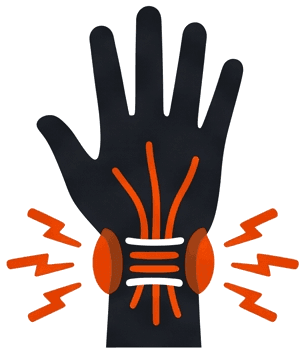
Carpal tunnel syndrome tends to show a distinct pattern: numbness or tingling concentrated in the thumb, index, and middle fingers, often worse at night or first thing in the morning, and frequently linked to repetitive wrist motion — typing, scrolling, gripping tools, or sleeping with your wrists bent underneath you. Shaking your hand out for relief is a classic sign people report without realizing it's a pattern doctors look for. If this sounds familiar, it's worth reading our deeper look at carpal tunnel without surgery, including what a carpal tunnel evaluation actually involves and the non-surgical options patients often want to understand before considering anything more invasive.
Could It Be Your Elbow?
If your numbness runs along your pinky and ring finger instead, the more likely culprit is the ulnar nerve at your elbow — the same nerve responsible for that jolt when you bump your "funny bone." Leaning on your elbows for long periods, or sleeping with your elbow bent tightly, can aggravate it. And if the numbness or tingling spreads beyond your hand into your forearm, or shows up alongside neck or shoulder discomfort, the nerve may be getting compressed much higher up the chain than your wrist or elbow at all.
When the Real Problem Is Your Neck
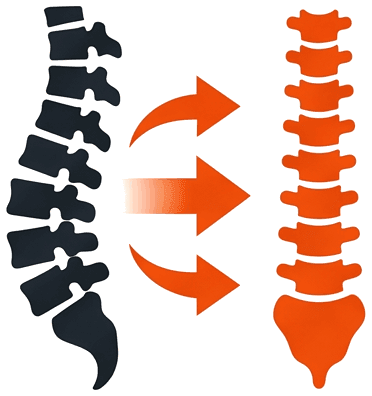
Numbness and tingling that spreads down your whole arm, involves more than one or two fingers, or comes and goes with certain neck positions often points to a pinched nerve higher up — where a nerve root exits your cervical spine and can get irritated by disc changes, joint restriction, or posture-related compression. Because the nerves supplying your hand all originate in your neck, a restriction there can produce symptoms that show up entirely in your fingers, which is part of why people are often surprised the actual problem isn't in their hand at all. We go deeper on this pattern in pinched nerve in neck: symptoms and how to find relief and in our overview of neck pain and what tends to drive it.
Everyday Habits That Make It Worse
A handful of everyday habits tend to aggravate nerve compression anywhere along this chain: hours of typing or scrolling without a break, sleeping with your wrists bent or your arm tucked under a pillow, gripping a steering wheel or tool tightly for long stretches, and forward-head posture that adds strain to the nerves exiting your neck. None of these alone cause permanent damage, but stacked together over months or years, they add up to the kind of chronic, low-grade compression that eventually gets your attention.
What a Neurological Evaluation Looks At
Because hand numbness can originate from several different points along the same nerve pathway, figuring out where it's actually coming from matters more than treating the symptom in isolation. At The Roots Health Centers, a visit starts with a consultation and a full neurological evaluation, so our doctors can see how your nervous system is functioning rather than guessing based on symptoms alone. Any necessary X-rays help rule out structural causes at the neck, and from there our doctors can walk you through what they're seeing and what a personalized plan might look like — since each case is different, the right approach depends on where along that chain your particular nerve is under pressure. Our chiropractic care uses Torque Release Technique, a low-force, instrument-assisted approach.
When to Get It Checked Right Away
Most hand numbness is a nerve-compression issue that's worth addressing but isn't an emergency. That said, some symptoms deserve same-day medical attention: sudden numbness or weakness on one side of your body, especially alongside slurred speech, facial drooping, or vision changes; numbness that appears suddenly after an injury; or numbness paired with loss of bladder or bowel control. Those aren't typical chiropractic-care scenarios — they warrant an ER visit or urgent medical evaluation first.
Frequently Asked Questions
What causes numbness and tingling in your hands? Most often, a nerve is being compressed or irritated somewhere between your neck and your fingertips — commonly at the wrist (carpal tunnel), the elbow (cubital tunnel), or the neck, where the nerves to your hand originate.
Is numbness in your hands serious? Occasional numbness after sleeping in an odd position usually isn't a concern. Numbness that's frequent, worsening, or paired with weakness is worth having evaluated, since the underlying cause determines what actually helps.
Why do my hands go numb at night? Nighttime numbness is often linked to wrist position during sleep (a common carpal tunnel pattern) or sustained pressure on a nerve at the elbow or neck while you're in one position for hours.
Can a pinched nerve in the neck cause hand numbness? Yes. Because the nerves supplying your hand originate in your cervical spine, irritation or compression at the neck can produce numbness and tingling that shows up entirely in your fingers, even though your neck feels fine.
When should I see someone about hand numbness? If it's frequent, spreading, paired with weakness, or not improving with simple changes like better wrist positioning, it's worth a neurological evaluation to identify where along the nerve pathway the compression is coming from.
If numbness or tingling in your hands has been nagging at you, a complimentary consultation is a good place to start. We'll walk you through a full neurological evaluation, explain what we're seeing, and talk through a personalized path forward.
The Roots Health Centers, 8209 Natures Way, Unit 115, Lakewood Ranch, FL 34202.
Conditions We Treat
Carpal Tunnel Syndrome
Drug-free, non-surgical care for carpal tunnel syndrome that addresses nerve compression at the wrist and the cervical spine — most patients avoid the operating room.

Pinched Nerve
A pinched nerve is a mechanical problem — a disc, joint, or inflamed tissue pressing on a nerve where it exits the spine. The pain, tingling, or numbness travels the nerve's path, which is why arm symptoms so often start in the neck.

Neck Pain
Precise cervical adjustments and decompression that restore alignment, reduce nerve pressure, and eliminate chronic neck pain at its source.