

Does Cracking Your Back Actually Help? What TRT Does Differently
If you find yourself twisting your torso in a chair or grabbing your own back for a satisfying pop several times a day, you've probably wondered: does cracking your back actually help, or am I just chasing a feeling? It's a fair question, and the honest answer is that self-cracking and a chiropractic adjustment are not the same thing, even though they can produce a similar sound. One releases gas from a joint. The other is a targeted, evaluated correction aimed at a specific restriction. Understanding the difference matters, especially if you find yourself needing to crack the same spot over and over without ever getting relief that lasts.
What Actually Happens When You Crack Your Back
That popping sound comes from a process called cavitation. Your spinal joints are surrounded by a capsule filled with fluid and dissolved gases. When you twist, bend, or stretch a joint past its normal range, the pressure inside the capsule drops suddenly, and dissolved gas forms a bubble that collapses with an audible pop. It's the same mechanism behind cracking your knuckles. The pop itself isn't dangerous, and the momentary looseness you feel afterward is real. Nerve receptors around the joint get a burst of input, which can temporarily ease the sensation of tightness. But cavitation doesn't correct anything structural. It's a release, not a repair.
Why the Relief Never Seems to Last
This is usually where the frustration sets in. If cracking your back worked the way people hope, one good pop would be enough. Instead, many people find themselves needing to crack the same segment multiple times a day, and the urge keeps coming back. That's often because the joint doing the popping isn't actually the restricted one. When one area of your spine isn't moving well, the segments above and below it tend to compensate by moving more than they should. Those hypermobile segments are usually the ones that crack easily, because they have gas to release. The genuinely restricted segment next to them, the one actually driving the tightness, often doesn't move enough to cavitate at all. That's a common pattern for anyone dealing with ongoing back pain or neck pain: temporary relief in the wrong place, while the real problem stays untouched.
What a Chiropractic Adjustment Does Differently
This is the core difference. A chiropractic adjustment isn't aimed at making a joint pop for the sake of it. At The Roots Health Centers, every adjustment follows a full neurological evaluation and any necessary X-rays, so the goal is to identify which specific segments aren't moving properly, not just which ones feel loose. The adjustment itself applies a precise, controlled force to a specific joint, in a specific direction, to help restore normal motion to a segment that's actually restricted. Sometimes that produces an audible release. Often it doesn't, and that's fine. The sound was never the point. The point is whether the joint is moving the way it's supposed to move.
What Is Torque Release Technique (TRT)?
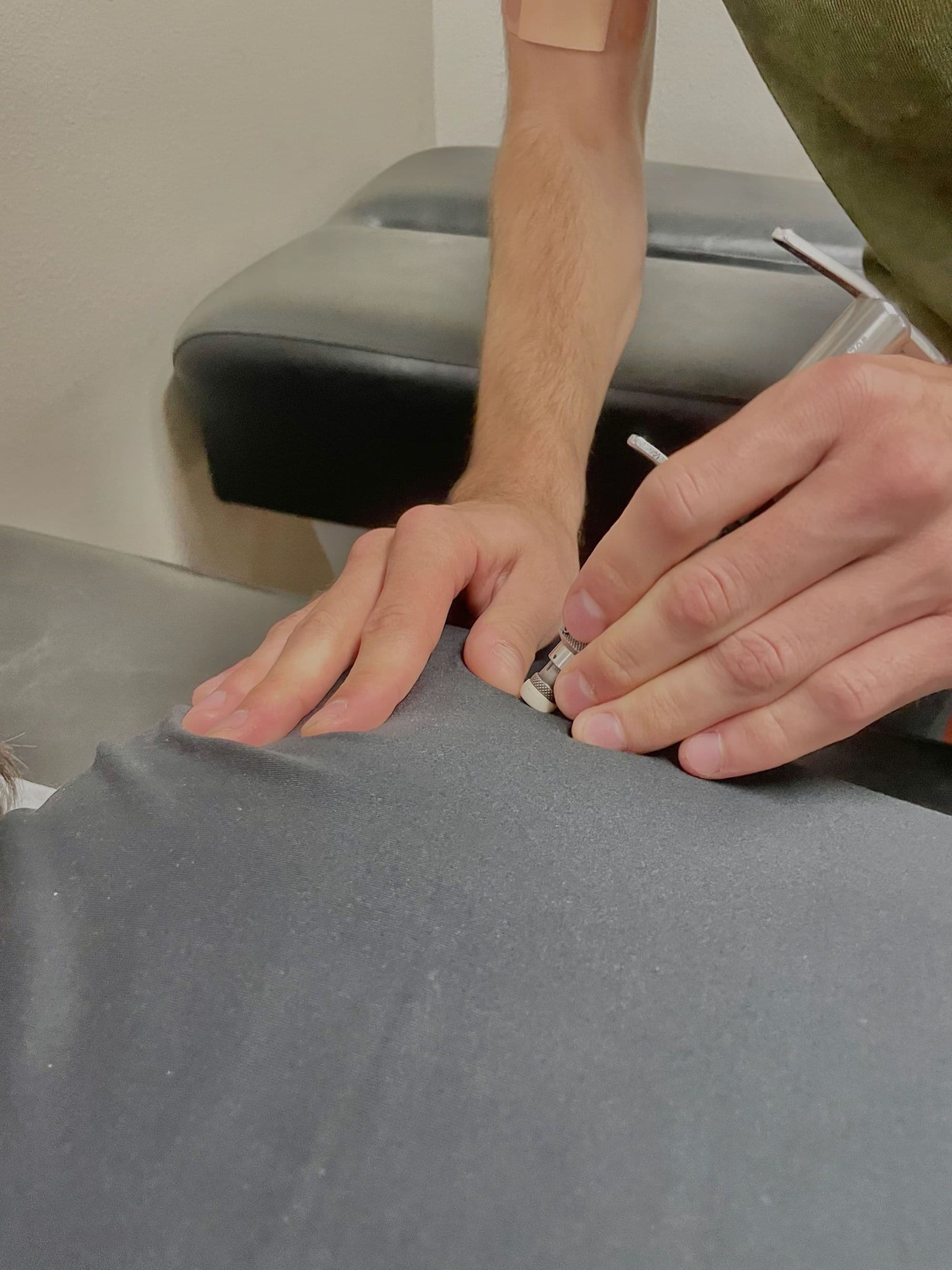
Our adjustments use Torque Release Technique, a low-force, instrument-based approach rather than the manual twisting most people picture when they think of a chiropractic adjustment. TRT uses a handheld instrument to deliver a precise, gentle force to a specific spinal segment, guided by what your evaluation actually shows. There's no forceful twisting, no holding your breath waiting for a big pop. For patients who've been self-cracking their back for years hoping for relief that never quite sticks, TRT is aimed at a different goal entirely: supporting the segment that's actually restricted, rather than releasing gas from the one that already moves too freely.
A Note on the Neck
Everything above applies to the back in general, but the neck deserves a little more caution. Self-manipulating the neck, especially with the fast, forceful twisting some people do to get a pop, involves smaller joints, more delicate structures, and less room for error than the lower back. This doesn't mean occasional neck cracking is dangerous for most healthy adults, but it does mean the neck is a poor candidate for guesswork. If your neck constantly feels like it needs cracking, that's a good reason to have a full evaluation rather than keep testing your own range of motion at your desk. If you've ever wondered whether chiropractic adjustments are safe, the honest answer starts with understanding what an adjustment is actually doing, which is where TRT comes in.
Is It a Problem to Crack Your Own Back?
Occasional self-cracking generally isn't harmful on its own. What's worth paying attention to is the pattern behind it. If you feel like you need to crack your back constantly just to feel normal, if the urge keeps returning within minutes or hours, or if the area feels loose or unstable rather than simply tight, that's worth having looked at. It can be a sign that nearby segments are compensating for a restriction elsewhere in the spine, which is exactly the kind of pattern a full evaluation is designed to find. Self-cracking usually isn't dangerous for most people. It's also rarely solving the actual problem.
Frequently Asked Questions
Is it bad to crack your own back? For most people, occasional self-cracking isn't harmful. The bigger issue is that it usually doesn't address whatever is actually causing the tightness, so the urge to crack tends to keep coming back.
Why does my back always feel like it needs to crack? This is often a sign that one segment of your spine is compensating for a nearby restriction. The hypermobile segment cracks easily and gets the attention, while the actual restricted joint stays untouched.
What's the difference between cracking your back and a chiropractic adjustment? Cracking releases gas from a joint capsule (cavitation) without addressing why the area feels tight. A chiropractic adjustment follows an evaluation and applies a targeted, controlled force to a specific segment that's actually restricted, whether or not it makes a sound.
Does Torque Release Technique make a popping sound? Sometimes, but it's not the goal. TRT uses a low-force instrument to address a specific segment, and any release of pressure is incidental to the correction, not the point of it.
How do I know if I need an actual adjustment instead of just cracking my own back? If self-cracking isn't giving you relief that lasts, or you find yourself doing it constantly throughout the day, that pattern is worth having evaluated. A full neurological evaluation can show which segments are actually restricted, rather than guessing from how something feels.
Chasing a pop is understandable, but it isn't the same as finding out what's actually going on in your spine. If you're tired of relief that never quite sticks, book a complimentary consultation at The Roots Health Centers in Lakewood Ranch. We'll walk you through a full evaluation and explain, in plain English, what we find and what Torque Release Technique can do differently for you.
Conditions We Treat


Services Related to This Post
Keep Reading
Related articles
What Is the Torque Release Technique — And Why Do We Use It?
Torque Release Technique is one of the most researched and precise chiropractic adjusting methods available. Here's why it's at the core of everything we do.
Read articleAre Chiropractors Safe? What to Know Before Your First Visit
Wondering if chiropractic adjustments are safe? Here's what the research shows, what the risks really are, and what to look for in a provider.
Read article