
pain-musculoskeletal

Frozen Shoulder: Your Real Recovery Options
The Roots Health CentersMarch 12, 20266 min read
Frozen Shoulder: Your Real Recovery Options

You reach for a coffee mug on the top shelf and your shoulder locks halfway up. You try to fasten your seatbelt and the arm will not rotate far enough behind you. You lie down at night and the shoulder throbs so intensely that you cannot find a position that lets you sleep for more than an hour. This is frozen shoulder — clinically called adhesive capsulitis — and if you have it, you already know that it does not just limit your range of motion. It takes over your life. The most frustrating part is what most doctors tell you: "It will resolve on its own in one to three years. Just be patient." For most people, waiting a year or more in that much pain is not a realistic plan. And the truth is, you do not have to.

What frozen shoulder actually is

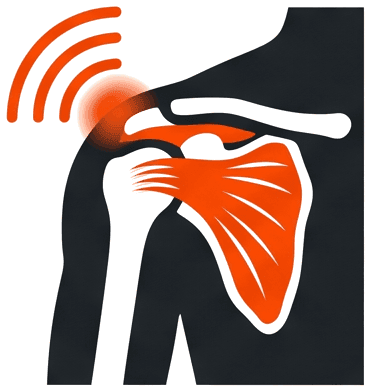
The shoulder is a ball-and-socket joint surrounded by a connective-tissue capsule. In frozen shoulder, that capsule becomes inflamed and progressively forms adhesions — thick bands of scar tissue that literally glue the capsule to itself. As the adhesions tighten, the joint loses range of motion in every direction.

The condition progresses through three well-documented stages:

  • Freezing (2-9 months) — pain increases gradually, and range of motion begins to decrease. Sleep is often the first casualty.
  • Frozen (4-12 months) — pain may stabilize or slightly decrease, but stiffness is at its worst. Daily tasks become extremely difficult.
  • Thawing (5-24 months) — range of motion slowly returns as the adhesions naturally break down.

The total cycle from onset to full resolution can take 1 to 3 years without intervention. Some patients never fully recover their original range of motion.

Who gets frozen shoulder

Frozen shoulder is not random. Certain populations are significantly more at risk:

  • Diabetics — up to five times more likely to develop frozen shoulder, and their cases tend to be more severe and slower to resolve
  • Women over 40 — the most common demographic
  • Post-surgical patients — especially after breast surgery, cardiac procedures, or any operation requiring prolonged immobilization of the arm
  • Thyroid patients — both hypo- and hyperthyroid conditions are associated with higher rates
  • Anyone after a shoulder injury — even a minor one that causes the person to guard the joint

The common thread is inflammation combined with reduced movement. Once the capsule starts tightening, the pain discourages use, which accelerates the adhesion cycle.

Why "wait it out" is a poor strategy

The natural history data shows that frozen shoulder does eventually resolve in most people. But "resolves" does not always mean "returns to normal." Research consistently shows that a significant percentage of patients retain measurable loss of range of motion years after the "thawing" phase supposedly ended. The longer the adhesions persist, the more permanent the structural changes become.

Waiting 18 months for a problem that responds to treatment in 8 to 12 weeks is not patience. It is unnecessary suffering.

The standard medical approach and its limitations

The typical medical path for frozen shoulder includes:

  • NSAIDs — reduce pain but do not address the adhesions
  • Cortisone injections — provide temporary anti-inflammatory relief inside the joint capsule, but the adhesions remain
  • Physical therapy — stretching and range-of-motion exercises help but progress is often agonizingly slow because the adhesions resist passive stretching
  • Manipulation under anesthesia (MUA) — the surgeon forcibly moves the arm through its full range while you are under general anesthesia, tearing the adhesions. Effective in many cases but carries risks (fracture, labral tear, nerve injury) and requires anesthesia
  • Arthroscopic capsular release — surgical cutting of the adhesions. Effective but invasive, with weeks of recovery

None of these address the underlying inflammation driving the adhesion formation, and none stimulate the tissue regeneration needed for full recovery.

Our frozen shoulder protocol

At The Roots Health Centers, we treat frozen shoulder with a multi-modality approach that targets every driver of the condition simultaneously:

  • Shockwave therapy — the centerpiece. Acoustic pressure waves physically break down adhesions inside the joint capsule, restore blood flow to the inflamed tissue, and trigger the body's natural repair cascade. Research on shockwave for adhesive capsulitis shows significant improvements in both pain and range of motion within weeks.
  • Red light therapy — reduces the chronic inflammation that drives adhesion formation and accelerates cellular repair. By addressing the inflammatory environment, red light therapy helps prevent new adhesions from forming as old ones are broken down.
  • Corrective chiropractic — the shoulder does not operate in isolation. The cervical spine, thoracic spine, scapula, and clavicle all contribute to shoulder mechanics. Misalignment or restriction in any of these areas increases compensatory stress on the shoulder capsule. Torque Release Technique adjustments restore the full kinetic chain.
  • Progressive range-of-motion rehabilitation — specific exercises prescribed at each stage of recovery to maintain and extend the gains from each treatment session.

What recovery actually looks like

Most patients experience a noticeable shift within the first two to four weeks:

  • Pain intensity decreases, especially at night
  • Sleep improves as nighttime shoulder pain diminishes
  • Small range-of-motion gains appear — reaching a few inches further, fastening a seatbelt with less struggle

By weeks four through eight, the improvements accelerate:

  • Overhead reach begins returning
  • Daily activities that were impossible become manageable
  • Pain shifts from constant to intermittent

Full recovery typically takes 2 to 4 months depending on severity — compared to the 1 to 3 year natural timeline. Patients who begin treatment in the freezing phase (before the joint is fully locked) tend to recover fastest. But even patients who have been frozen for six months or longer respond well — it simply takes more sessions.

Dr. Logan Swaim monitors progress with range-of-motion measurements and pain assessments at defined intervals. If progress stalls, the protocol is adjusted.

The kinetic chain matters

Frozen shoulder rarely develops in a vacuum. Most patients have pre-existing issues that set the stage:

  • Neck pain and cervical misalignment — the nerves that supply the shoulder originate in the cervical spine. Compression or irritation there can create the inflammatory environment that triggers capsulitis.
  • Thoracic stiffness — a rigid mid-back forces the shoulder to compensate for lost thoracic rotation.
  • Desk posture and forward-head position — chronic rounding of the shoulders changes scapular mechanics and loads the shoulder capsule unevenly.

Addressing these upstream factors is why chiropractic care is a critical part of the frozen shoulder protocol, not an optional add-on. Treating the shoulder in isolation often leads to recurrence.

Preventing recurrence

Once frozen shoulder has resolved, the goal is to ensure it does not return — especially since having it once increases the risk of it happening again or developing on the other side. Our maintenance recommendations include:

  • Ongoing chiropractic wellness care at a reduced frequency
  • Daily shoulder mobility exercises (we provide a specific home program)
  • Ergonomic modifications for desk and driving positions
  • Early intervention at the first sign of renewed stiffness

The patients who maintain these habits rarely experience recurrence.

If you have been told to "wait it out" or your frozen shoulder is not responding to physical therapy alone, there is a faster, more effective path. See patient case studies for examples of recovery timelines. Book your $49 new patient special with Dr. Logan Swaim or call (941) 877-1507.

Have a Health Question?

Call us or book a consultation. We'd love to help.