
pain-musculoskeletal

Carpal Tunnel Without Surgery: A Different Approach
The Roots Health CentersMarch 18, 20266 min read
Carpal Tunnel Without Surgery: A Different Approach

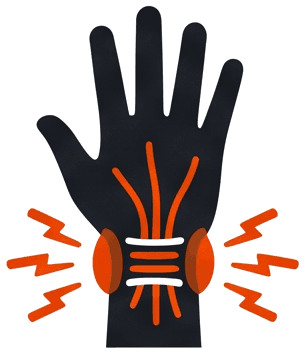
Carpal tunnel surgery has a frustrating reputation problem: a meaningful percentage of patients still have symptoms after the procedure. Sometimes the surgery helps for a few months and the numbness comes back. Sometimes it never helps at all. The reason is not that the surgeon did anything wrong. It is that carpal tunnel syndrome is rarely just a wrist problem. The median nerve — the nerve compressed in carpal tunnel — does not start at your wrist. It starts at your cervical spine, travels through your shoulder, past your elbow, and into your hand. Compression anywhere along that path produces the same symptoms at the fingertips. Surgery only addresses the wrist. If the driver is upstream, the wrist release does not fix it.

The anatomy most patients never hear about

The median nerve originates from nerve roots C5 through T1 in your neck. It travels through three anatomical tunnels on its way to your hand, and it can be compressed at any of them:

  • The cervical spine — a disc bulge, herniation, or vertebral misalignment at C5-C7 can compress the nerve root before it even leaves the neck
  • The thoracic outlet — the narrow space between the collarbone and first rib, where the nerve passes alongside blood vessels. Tight scalene muscles, poor posture, or a cervical rib can compress the bundle here
  • The pronator teres at the elbow — the nerve passes through a muscular tunnel in the forearm that can become tight and restrictive
  • The carpal tunnel at the wrist — the most famous site, where the nerve passes beneath the transverse carpal ligament

This is called the "double crush" phenomenon: when a nerve is mildly compressed at one site, it becomes more vulnerable to compression at a second site downstream. Many carpal tunnel patients have two or even three compression points working together to produce symptoms.

Why carpal tunnel surgery fails for some patients

Carpal tunnel release surgery involves cutting the transverse carpal ligament at the wrist to give the median nerve more room. When the wrist is the only compression site, the surgery works well. But when the real driver is cervical misalignment or thoracic outlet compression — which is surprisingly common — cutting the ligament at the wrist addresses the wrong problem.

Patterns we see regularly in patients whose surgery did not resolve their symptoms:

  • Symptoms returned within 6 to 12 months of the procedure
  • Numbness improved in some fingers but not others
  • Grip strength did not return to normal
  • Neck pain or shoulder tightness was present before and after the surgery
  • Symptoms are in both hands, suggesting a more systemic or proximal cause

If the nerve is compressed at C6 and at the wrist, releasing the wrist alone removes only half the pressure. The nerve is still compromised upstream, and the symptoms persist.

How we evaluate the full nerve path

At The Roots Health Centers, every carpal tunnel patient receives a comprehensive evaluation that traces the median nerve from the cervical spine to the fingertips:

  • CLA INSiGHT nerve scans — measuring muscle tension patterns, autonomic function, and heart rate variability to identify areas of nervous system stress
  • Orthopedic and neurological testing — specific provocative tests at each compression site (Spurling's for the neck, Adson's and Wright's for the thoracic outlet, Phalen's and Tinel's for the wrist)
  • Digital x-rays when indicated — evaluating cervical alignment, disc spacing, and structural integrity
  • Range-of-motion and grip-strength baselines — so we can measure real progress over time

Dr. Logan Swaim reviews all findings with you and identifies exactly where the compression is occurring. In our experience, a significant number of patients referred for carpal tunnel surgery actually have their primary compression site in the cervical spine or thoracic outlet — not the wrist.

When we trace the nerve path from the neck to the fingers, the real source of compression is often nowhere near the wrist. That is why a complete evaluation before surgery can change the entire treatment plan.

The non-surgical treatment protocol

Once we know where the compression is, the treatment plan targets each site specifically:

  • Corrective chiropractic using the Torque Release Technique — addressing cervical and upper thoracic misalignment that compresses nerve roots at the spine. Gentle, precise, no twisting or cracking.
  • Shockwave therapy — breaking down adhesions and scar tissue in the scalene muscles, pectoralis minor, pronator teres, and other soft-tissue structures that create nerve compression. Shockwave restores blood flow and stimulates tissue remodeling.
  • Red light therapy — reducing chronic inflammation along the entire nerve pathway. Inflammation is often the factor that pushes a mildly compressed nerve from "annoying" to "debilitating."
  • Targeted rehabilitation — specific stretches and nerve-gliding exercises designed to mobilize the median nerve through each tunnel and prevent re-adhesion
  • Ergonomic modifications — workstation setup, keyboard and mouse positioning, wrist support recommendations based on the specific compression pattern

Most care plans run 6 to 12 weeks depending on severity and the number of compression sites involved.

What results look like

Patients with proximal (neck or thoracic outlet) compression often notice improvement quickly — sometimes within the first two weeks — because the cervical spine responds well to corrective adjustment. Patients with combined proximal and distal compression take longer because multiple sites need to resolve.

Typical progression:

  • Weeks 1-3 — reduced numbness frequency, improved sleep (nighttime symptoms are often the first to resolve)
  • Weeks 4-8 — grip strength improves, daytime tingling decreases, range of motion in the neck and shoulder opens up
  • Weeks 8-12 — consolidation; most patients report that numbness is gone or reduced to occasional episodes under heavy use

We re-test grip strength and provocative tests at defined intervals so progress is measurable — not just subjective.

Who benefits most

The patients who respond best to non-surgical care:

  • Have not yet had surgery — the nerve pathway is intact and responsive to correction
  • Have neck or shoulder symptoms alongside hand numbness — a strong indicator of proximal compression
  • Have bilateral symptoms — both hands affected suggests a cervical or systemic driver
  • Have symptoms that worsen with neck position — looking up, turning the head, or holding the phone to the ear
  • Work at a desk — forward-head posture and rounded shoulders are major contributors to thoracic outlet compression

Even patients who have already had carpal tunnel release surgery and still have symptoms often respond well when we address the cervical and thoracic components the surgery did not touch.

When surgery is the right call

We are not anti-surgery. When the compression is genuinely isolated to the carpal tunnel — confirmed by nerve conduction studies and supported by our evaluation — and conservative care has not resolved the symptoms, carpal tunnel release is a reasonable and effective procedure. We refer to trusted hand surgeons in the Sarasota-Bradenton area when the clinical picture supports it.

But if surgery has been recommended based only on wrist-level evaluation, without anyone examining the cervical spine, thoracic outlet, or full nerve path, a second opinion is worth your time.

If you are dealing with hand numbness, tingling, or weakness — whether you have been told it is carpal tunnel or not — the right first step is a full nerve-path evaluation. See patient case studies for examples of how patients recover. Book your $49 new patient special with Dr. Logan Swaim or call (941) 877-1507.

Have a Health Question?

Call us or book a consultation. We'd love to help.