

Herniated Disc vs. Bulging Disc: What's the Difference?
You get an MRI because your back pain has been persistent, and a few days later you open the report and see phrases like "bulging disc at L4-L5" or "herniated nucleus pulposus at L5-S1." Your heart sinks. The language sounds catastrophic. You start imagining surgery, permanent disability, a life of limited activity. Then — often without much explanation — you get referred to a surgeon or told to "consider physical therapy and see if surgery is needed." Most people go through this experience more anxious than they need to be, and often end up pursuing aggressive treatment for findings that do not require it.
Basic disc anatomy
Your spine is a stack of vertebrae with a shock-absorbing pad — the intervertebral disc — between each pair. Each disc has two main components:
- The annulus fibrosus — a thick outer ring of tough collagen arranged in concentric layers, like the rings of an onion
- The nucleus pulposus — a soft, gel-like inner core made largely of water and proteoglycans
Together they let the disc compress under load and rebound when the load releases. Discs become mostly avascular by adulthood — they rely on fluid exchange from adjacent vertebral endplates, which is one reason they are slow to heal when damaged.
What "bulging" actually means
A bulging disc is when the entire disc — the annulus and nucleus together — shifts outward beyond its normal position in the spinal canal. Think of a hamburger patty pushed a little past the edges of its bun. The outer wall is still intact. No material has escaped.
Bulging discs are very common:
- About half of adults over 40 have at least one bulging disc on MRI
- By age 60, that number is well over 70%
- Many cause no pain at all and are discovered incidentally
A bulging disc on an MRI, by itself, is not a diagnosis. It is an imaging finding that needs to be correlated with clinical symptoms.
What "herniated" actually means
A herniated disc is more specific. The outer wall has actually torn, and the inner nucleus material has pushed through the tear. Depending on how far the material has escaped, the clinical terms get specific:
- Protrusion — the nucleus has pushed into the annulus but is still contained by the outer fibers
- Extrusion — the nucleus has broken through the outer annulus and is spilling out
- Sequestration — a piece of the nucleus has broken off and is floating free in the spinal canal
Each is progressively more advanced. Herniated discs cause problems when the displaced material presses on a nerve root or the spinal cord, producing radiating pain, numbness, tingling, or weakness along the nerve's distribution.
How the symptoms differ
You cannot tell the difference definitively without imaging — symptoms can overlap, and many imaging findings do not match symptom severity. But there are patterns:
Bulging discs usually produce:
- Localized stiffness and low-grade pain
- Pain worse in certain positions (morning, after prolonged sitting)
- Mild radiation into buttocks or shoulders, but not down a full limb
- Rarely numbness, tingling, or true weakness
Herniated discs more often produce:
- Radiating pain along a specific nerve path (sciatica for lumbar, arm pain for cervical)
- Sharp, electrical, or burning quality
- Numbness and tingling in the same distribution
- True muscle weakness — leg giving out, trouble lifting the foot, loss of grip
- Pain worse with bending forward, sitting, coughing, or sneezing
When it is actually dangerous
Most bulging discs are not dangerous. They are a common aging change and often remain stable or improve over time. Herniated discs more often require active management.
Cauda equina syndrome is the red flag that makes any disc condition urgent:
- Loss of bowel or bladder control
- Saddle anesthesia (numbness in groin and inner thighs)
- Progressive bilateral leg weakness
These findings are rare but genuinely emergent and require immediate evaluation, often surgical. The vast majority of disc patients do not have cauda equina findings.
Most herniated discs do not require surgery. Multiple studies show the majority — even significant ones on MRI — resolve or respond to conservative care over 6 to 12 months.
Treatment options for bulging discs
For mild to moderate symptoms, conservative care is almost always the right first step:
- Corrective chiropractic to address segmental misalignment loading the disc
- Postural and ergonomic changes to reduce daily stress
- Targeted rehabilitation for deep core stabilizers
- Inflammation management
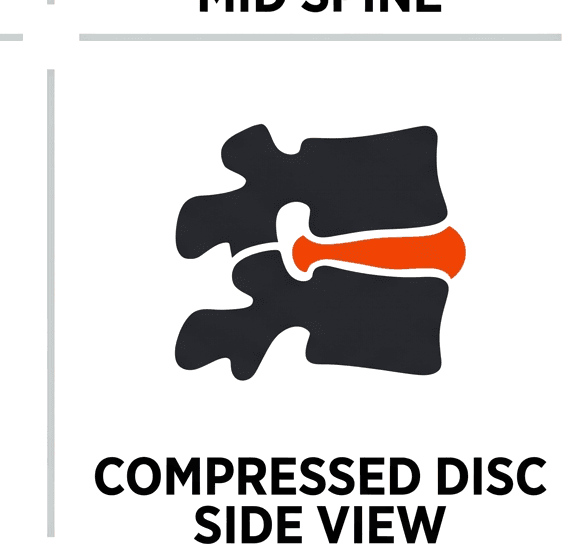
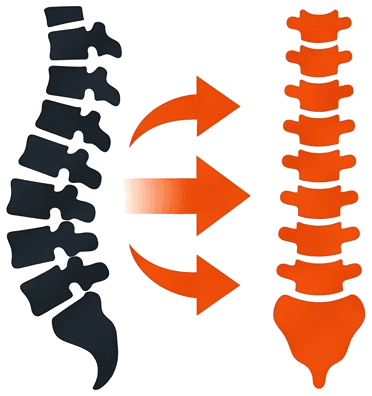
For bulges that are more symptomatic or resistant to initial care, FDA-cleared non-surgical spinal decompression is the next step. Decompression creates negative pressure inside the disc capsule, pulling fluid, oxygen, and nutrients back into the disc and helping retract the bulged material inward. Combined with shockwave therapy for soft tissue restrictions and red light therapy for inflammation, it gives the disc the best chance to heal.
Treatment options for herniated discs
This is where people get confused, because the word "herniation" often triggers a surgical reflex. The reality: most herniated discs do not require surgery. The body has its own mechanism for reabsorbing herniated material.
Conservative treatment typically includes:
- Non-surgical spinal decompression — the main tool for significant disc conditions
- Corrective chiropractic adjusting around and supporting the affected segment
- Specific rehabilitation exercises
- Inflammation control via red light therapy and dietary changes
- Epidural steroid injections for severe radicular pain during healing (in some cases)
Surgery is reserved for a minority of cases where conservative care has failed, where there is progressive neurological deficit, or where cauda equina findings are present.
Non-surgical spinal decompression, explained
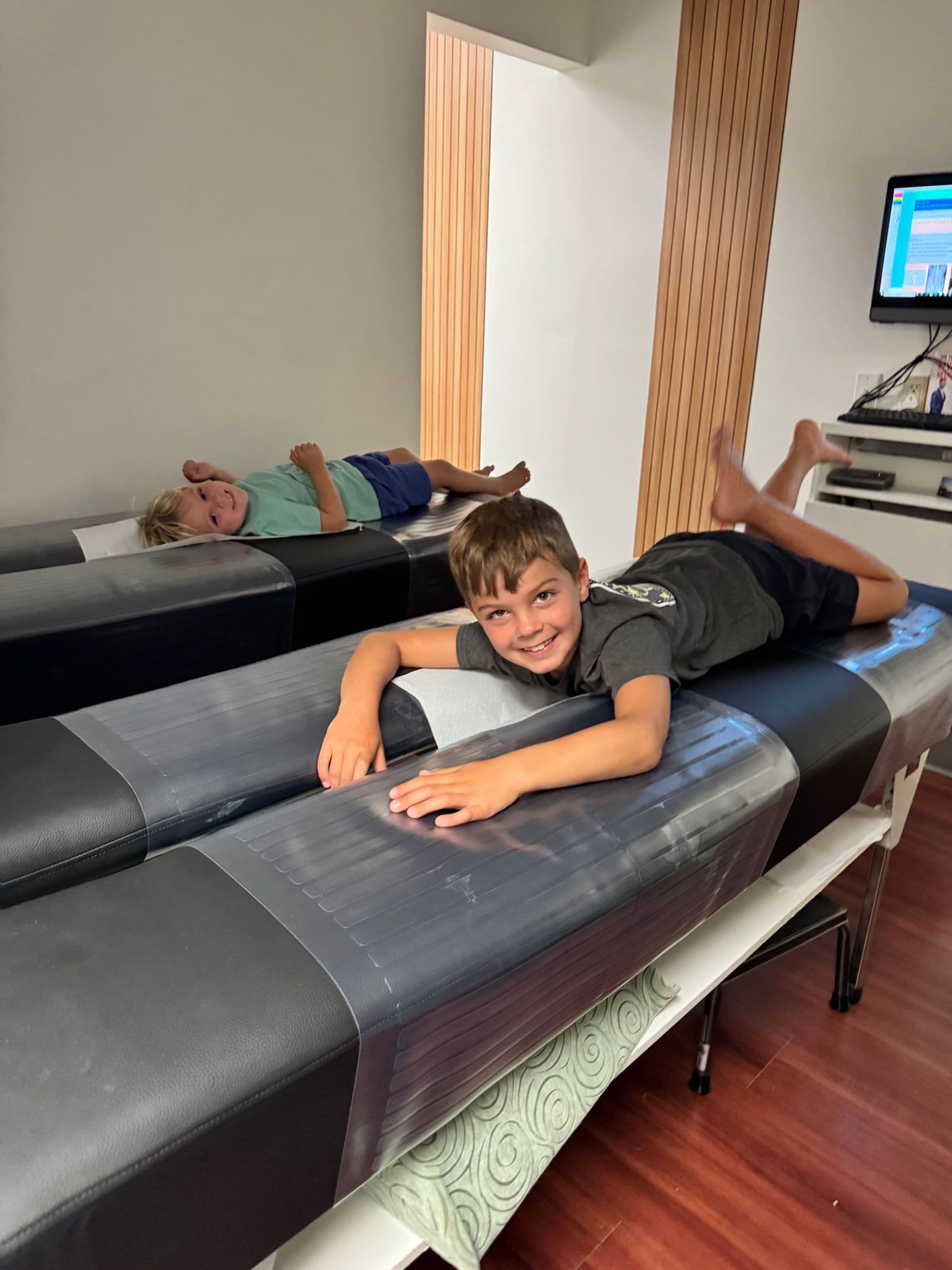
Decompression is not traction:
- Traction pulls on the spine generally
- Decompression is precisely controlled, computer-guided, and targets the specific affected segment
- You are harnessed into a decompression table
- The table gently stretches the involved segment in cycles — pulling for a set period, releasing, pulling again
The controlled pulling creates negative pressure inside the disc capsule, reversing the inward pressure that normally pushes disc material outward. Over a course of 20 to 24 sessions, the cumulative effect is meaningful — the bulge reduces, herniated material partially retracts, the disc rehydrates, and the nerve root finds breathing room.
Predictors of good outcomes
A few factors consistently predict which disc patients do best with non-surgical care:
- Shorter duration of symptoms (3 months or less) — but long-standing cases still respond meaningfully
- Younger patients with better baseline fitness
- Fewer adjacent segments involved
- Non-smoker, non-obese, lower chronic stress
- Commitment to the full course of care
Disc healing is not fast. Patients who push through the full 20 to 24 sessions almost always do better than those who stop early when they start feeling better.
When to get a second opinion
If you have been told you need surgery, a second opinion from a non-surgical provider is almost always worth pursuing first. This is not anti-surgery — we refer to spine surgeons when it is truly indicated. But:
- Most disc conditions respond to conservative care
- Surgery is essentially irreversible
- Lumbar microdiscectomy has a meaningful rate of recurrence
- Spinal fusion often leads to adjacent segment disease 5 to 15 years later
If you have no surgical red flags and you have not yet tried decompression-based care, that path is worth exploring.
If your MRI mentions a bulging or herniated disc, or if you are having symptoms that suggest a disc issue, we would be glad to review your imaging with you. An MRI finding is not a life sentence — for most people, it is information that leads to a manageable path forward. See patient case studies for examples, or book a complimentary consultation with Dr. Logan Swaim. Call (941) 877-1507 to schedule.
Conditions We Treat
Herniated Disc
Non-surgical care for herniated and bulging discs using FDA-cleared spinal decompression, corrective chiropractic, and integrated soft-tissue therapies.
Back Pain
Corrective chiropractic care that addresses the structural root cause of back pain — not just masking symptoms with medication.
Sciatica
Non-surgical care for sciatic nerve pain using spinal decompression, corrective chiropractic, and supporting therapies.
Services Related to This Post
Keep Reading
Related articles
5 Signs Your Back Pain Isn't Just Muscular
Not all back pain is created equal. If you're experiencing these warning signs, the problem might be deeper than tight muscles.
Read articleSpinal Decompression Therapy: How Non-Surgical Decompression Works and Who It Helps
What non-surgical spinal decompression actually is, how it differs from surgery and basic traction, and which back and disc problems it helps.
Read articleSciatica: What Causes It, What It Feels Like, and How to Find Relief Without Surgery
Sciatica is nerve pain that travels from your low back down the leg. Here's what causes it, the red flags to know, and a non-surgical path to relief.
Read article