
Knee Decompression Explained: A Non-Surgical Path to Knee Pain Relief
If you have been told your knee pain options come down to anti-inflammatories, cortisone injections, or eventual knee replacement surgery, there is a treatment you probably have never heard of. Knee decompression uses the same FDA-cleared technology that has been successfully treating spinal disc conditions for decades — adapted specifically for the knee joint. It is one of the very few non-surgical treatments that targets the mechanical root cause of knee pain rather than masking the symptoms. At The Roots Health Centers in Lakewood Ranch, it is a core part of how we help patients get back on their feet without the operating room.
Why knee pain becomes chronic
The knee is a hinge joint that bears your full body weight with every step. The surfaces of the joint are cushioned by articular cartilage and shock-absorbing menisci. Unlike muscle, cartilage has almost no direct blood supply. It depends on the movement of synovial fluid — the joint's natural lubricant — to deliver nutrients and remove waste. When the joint is inflamed, overloaded, or stiff, that fluid exchange slows dramatically.
The result is a vicious cycle:
- Cartilage is starved of nutrients and begins to thin
- Thinning cartilage leads to more friction and inflammation
- Inflammation leads to swelling and stiffness
- Stiffness reduces movement, further reducing fluid exchange
- The cartilage continues to deteriorate
This is why conventional treatments — rest, ice, cortisone — provide temporary relief but rarely reverse the trajectory. They manage the symptoms while the underlying problem continues to progress. The joint never gets what it actually needs: restored fluid dynamics, reduced mechanical load, and an environment that supports cartilage repair.
How knee decompression works
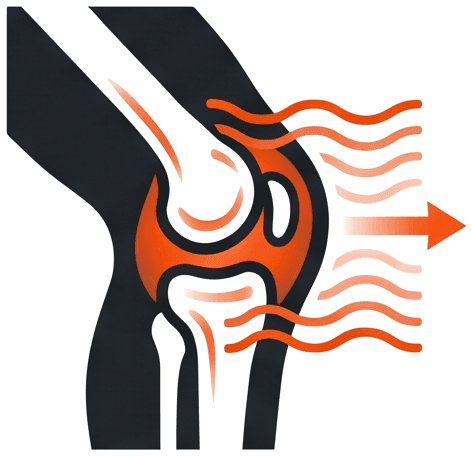
Knee decompression therapy uses a specialized table that secures your leg in a precision harness. The table then gently separates the bone surfaces of the knee joint in controlled, rhythmic cycles — pulling apart, releasing, pulling apart again.
This cyclical traction creates negative pressure inside the joint capsule. That negative pressure does three critical things:
- Pulls synovial fluid, oxygen, and nutrients back into cartilage that has been chronically starved of blood flow
- Unloads the damaged cartilage surfaces so they are no longer grinding under full body weight
- Reduces internal joint pressure that contributes to inflammation and nerve irritation
The mechanism is analogous to how spinal decompression works for disc conditions — creating the conditions for tissue repair that the body cannot generate on its own when the joint is under constant compression.
Each session takes about 20 to 30 minutes. The sensation is a gentle, rhythmic stretching — most patients describe it as comfortable and even relaxing.
Who is a good candidate
Knee decompression works best for patients with:
- Osteoarthritis — the most common reason patients come in, especially Grade 2 and Grade 3
- Meniscus tears and degeneration — particularly degenerative tears that are not surgical candidates
- Chronic knee stiffness and reduced range of motion — the kind that makes stairs, squatting, and getting out of a chair difficult
- Post-surgical knee pain — patients who had a procedure but did not get the relief they expected
- "Bone-on-bone" imaging findings — even patients told they need knee replacement often respond meaningfully
Age is not a barrier. Many of our knee decompression patients are in their 60s, 70s, and even 80s. The treatment is gentle, requires no anesthesia, and involves zero recovery time between sessions.
Most people have never heard of knee decompression — but for patients staring down a knee replacement, it is often the treatment that changes the conversation entirely.
Why we combine it with other modalities
Decompression addresses the mechanical environment inside the joint. But knee pain is rarely caused by one factor alone. At The Roots Health Centers, knee decompression is part of a multi-modality protocol:
- Shockwave therapy — acoustic pressure waves stimulate healing in damaged tendons, ligaments, and soft tissue around the knee. Shockwave triggers angiogenesis (new blood vessel formation) and breaks down chronic scar tissue that restricts joint movement.
- Red light therapy — photobiomodulation reduces inflammation at the cellular level and increases ATP production in the damaged tissue. For arthritic knees with chronic low-grade inflammation, this is a critical piece.
- Corrective chiropractic — the knee does not operate in isolation. Hip alignment, ankle mobility, lumbar spine mechanics, and pelvic balance all affect how forces distribute through the knee. Misalignment anywhere up the kinetic chain puts uneven stress on the joint.
Having all four modalities under one roof means Dr. Logan Swaim can coordinate the protocol instead of sending you to three different providers.
What results look like
Patients typically follow a course of 20 to 24 decompression sessions over 8 to 12 weeks, with supporting modalities layered in based on their specific findings.
Typical progression:
- Weeks 1-3 — reduced stiffness, improved morning mobility, early pain reduction
- Weeks 4-8 — meaningful improvement in walking tolerance, stairs become easier, swelling decreases
- Weeks 8-12 — gains consolidate; many patients return to activities they had stopped — gardening, walking the neighborhood, getting up from a chair without bracing
Not every patient avoids surgery. Some knee joints are too far gone for conservative care to make a meaningful difference, and in those cases we refer to trusted orthopedic surgeons in the Sarasota-Bradenton area. But the majority of patients who come through our door with moderate to moderately-severe knee arthritis see substantial improvement.
Cortisone vs. decompression
Cortisone injections are the most common conventional treatment for knee arthritis. They work by suppressing inflammation — which provides temporary pain relief, often lasting 3 to 6 months. But cortisone does not:
- Heal cartilage
- Improve joint mechanics
- Restore fluid exchange
- Address upstream compensation patterns
Repeated cortisone injections carry real risks: cartilage degradation, tendon weakening, and fat pad atrophy. Research published in Radiology has documented accelerated joint deterioration in patients receiving repeated cortisone injections compared to controls. Cortisone manages the symptom. Decompression treats the mechanism.
The earlier the better
Cartilage damage is progressive. The earlier you intervene — before the joint surfaces are severely eroded — the better the long-term outcome. Patients who start decompression at Grade 2 arthritis generally respond faster and more completely than those at Grade 4.
If your knee has been hurting for months or years and the only options you have been offered are medication, injections, or surgery, knee decompression is worth a serious conversation. See patient case studies for examples of how knee patients progress through care. Book your $49 new patient special with Dr. Logan Swaim or call (941) 877-1507.
Conditions We Treat
Knee Pain
Non-surgical knee pain relief using knee decompression, shockwave therapy, red light therapy, and corrective chiropractic — addressing the mechanical root cause of joint dysfunction.

Arthritis
Drug-free arthritis care that reduces joint inflammation, slows degeneration, and restores function — using corrective chiropractic, decompression, red light therapy, and shockwave.