

Knee Pain When Squatting: Why It Happens and What Helps
You lower into a squat to pick something up, tie a shoe, or get off the couch, and your knee lets you know about it. Knee pain when squatting is one of the most common complaints we hear in Lakewood Ranch, and the short answer is that the knee is usually reacting to something above or below it. The knee is a hinge that sits between two very mobile joints, the hip and the ankle, and when either one is stiff or the spine is not sharing the load well, the knee often takes the extra stress. Below, we'll walk through the common reasons squatting hurts, what the location of your pain can suggest, the warning signs that call for a prompt exam, and how our team approaches it. This is educational and not a diagnosis.
Why Squatting Puts So Much Demand on the Knee
A squat asks your whole lower body to work as one system. Your ankles bend, your knees travel forward, your hips fold back, and your spine stays steady while your muscles control the descent. When every link in that chain moves well, the load spreads out. When one link is limited, another one compensates.
That is why a stiff ankle can show up as knee pain, and why a tight hip can send the knee drifting inward. The kneecap (patella) glides in a groove at the end of the thigh bone, and small changes in how the leg is aligned can change how that glide feels. Add body weight, a deep range of motion, and repetition, and a small mechanical issue can turn into a daily annoyance.
The nervous system also plays a part. Your brain constantly adjusts muscle timing based on feedback from the joints. If a joint has been irritated for a while, that feedback can change, and the muscles that should be stabilizing the knee may not fire as smoothly as they should. Our broader guide to chiropractic care for knee pain explains how we think about this whole-chain picture.
Common Reasons Knee Pain Shows Up When You Squat
Most people have more than one contributor. Here are the patterns we see most often.
Irritation around the kneecap
Pain at the front of the knee, often described as aching or grinding when you bend deeply or climb stairs, is commonly linked to how the kneecap tracks. Sitting for long periods, sudden increases in activity, and weak or tight muscles around the hip can all contribute. Our post on knee pain going down stairs covers this pattern in detail.
Tight hips and stiff ankles
If your hips or ankles cannot bend enough, your knees may be asked to do a job that belongs to those joints. People who spend most of the day sitting often notice that deep squats feel "stuck" long before the knee itself is the real limit.
Meniscus irritation
The meniscus is the cartilage cushion inside the knee. Deep bending and twisting under load can irritate it, and some people notice catching, clicking with pain, or a sense that the knee will not fully straighten. Not every click is a problem, but pain with catching deserves an exam. See our overview of non-surgical options for meniscus tears.
Tendon overload
The tendons above and below the kneecap can become sore when they are asked to do more than they are ready for, such as a new exercise routine, a jump in pickleball or golf time, or lots of yard work.
Wear and tear in the joint
As we age, the cartilage in the knee can thin, and squatting can be one of the first movements to feel stiff or achy. That does not automatically mean something is wrong, and it does not mean you have to stop moving. Our post on avoiding knee replacement explains what conservative care can look like.
A pinched nerve or low back contribution
Sometimes knee pain is referred from the low back or hip. If your knee pain comes with back pain, pain that travels down the leg, or numbness and tingling, the spine may be part of the story. Our page on sciatica describes how that pattern can show up.
What the Location of Your Pain Can Suggest
These are patterns, not diagnoses, but they give you something useful to describe at an appointment:
- Front of the knee, around or behind the kneecap: often related to kneecap tracking, tendon load, or hip control.
- Inner side of the knee: may involve the meniscus, the ligament on that side, or how the foot and arch are loading.
- Outer side of the knee: often linked to the band of tissue along the outside of the thigh and hip control.
- Back of the knee: can be muscle tightness, but swelling or calf pain deserves a prompt medical check.
- Deep, aching pain at the bottom of the squat: often a mix of joint compression and limited hip or ankle motion.
- Pain only when you start moving after sitting: common with stiffness and early joint wear.
If you want to dig into the topic as a whole, our knee pain condition page pulls the common presentations together in one place.
Warning Signs That Need a Prompt Exam
Most squatting pain is mechanical and manageable, but some signs should not wait. Seek urgent medical care if you have:
- A knee that is hot, red, and swollen, especially with a fever.
- Pain after a fall or twisting injury, with a pop and immediate swelling.
- A knee that locks, gives way, or will not bear weight.
- Calf pain, warmth, and swelling in one leg, which can signal a blood clot.
- Numbness, weakness, or loss of bladder or bowel control along with leg pain.
Book a prompt exam if the pain keeps waking you at night, is getting steadily worse, or has not eased even though you have backed off the activity that triggers it.
Things That May Be Worth Trying While You Get Answers
Each person and case is different, so think of these as general ideas rather than a plan.
- Change the depth, not the habit. A shallower squat or a chair-assisted squat lets you keep moving without provoking the pain.
- Check your foot position. Slightly turning the toes out and keeping your weight spread across the whole foot can change how the knee feels.
- Warm up the hips and ankles. A few minutes of gentle motion before activity helps those joints do their share of the work.
- Break up long sitting. Standing and moving every so often keeps the hips and knees from stiffening.
- Ramp up gradually. If pain started after a jump in activity, scaling back and building up more slowly gives tissue time to adapt.
- Pay attention to footwear. Worn-out shoes change how forces travel up the leg.
If these ideas make no difference, or you are unsure what is driving the pain, a hands-on evaluation is a better next step than guessing.
How We Look at Knee Pain at The Roots
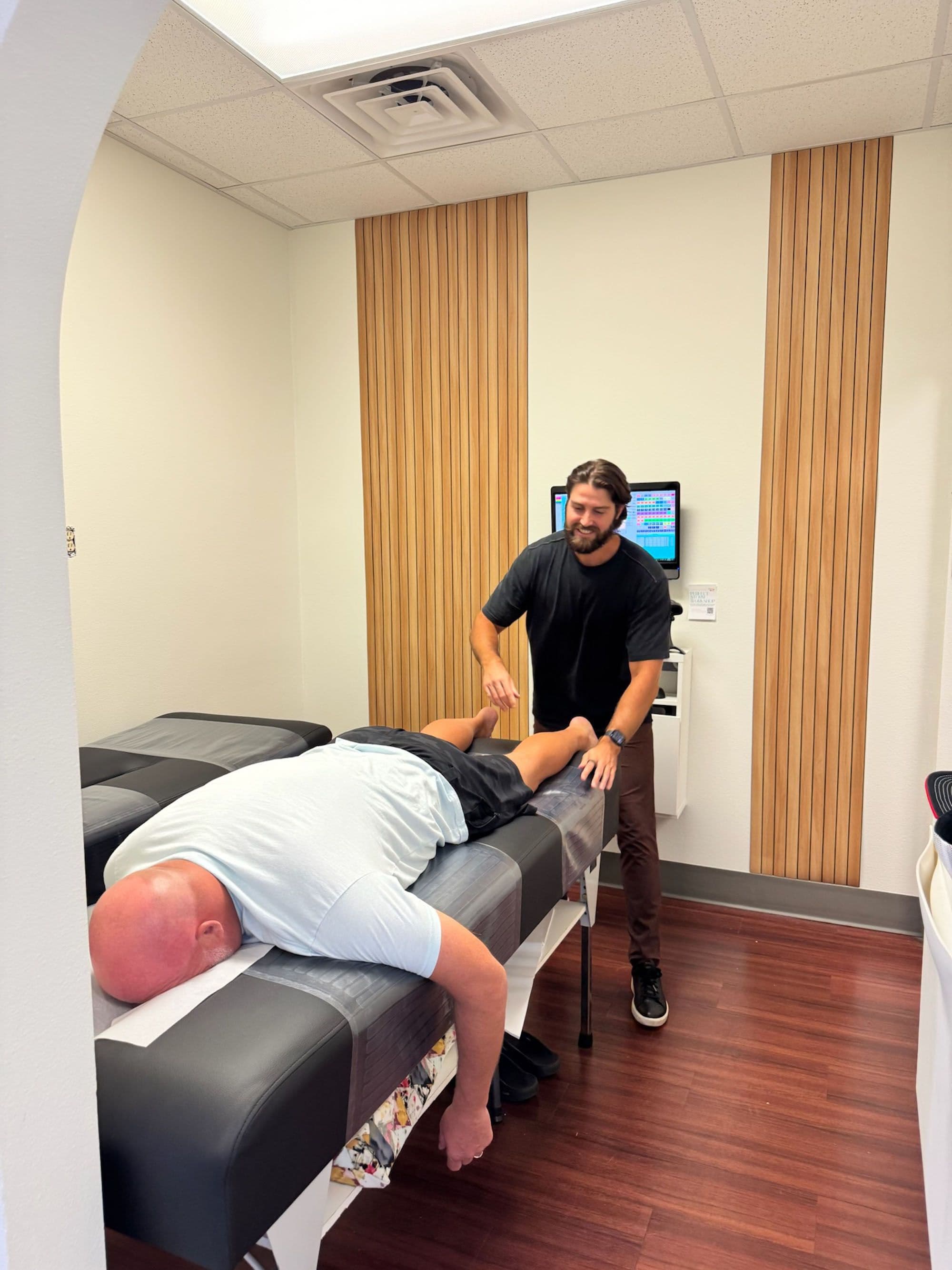
At The Roots Health Centers, we start with your story: what you were doing when the pain began, which movements bother it, and what else has been going on in your body. Then we look at how you move. We check the knee, but we also check the hips, ankles, low back, and the way your nervous system is coordinating the whole chain. Any necessary X-rays are part of that picture, and if something falls outside our scope, we will say so and point you to the right provider.
From there, our team recommends a personalized approach. That may include gentle chiropractic care for the spine, hips, and joints that influence the knee. For some people, knee decompression is an option our doctors may discuss after an exam. We never promise a particular outcome, because every person and every knee is different, but we do aim to find the pattern behind your pain so your plan fits you.
Frequently Asked Questions
Why does my knee hurt when I squat down?
Because a squat loads the knee while the hips and ankles bend. If either of those joints is stiff, or the muscles controlling the kneecap are not working in sync, the knee often absorbs the extra stress. Irritation around the kneecap, the meniscus, or the tendons are among the common contributors.
Is it bad to squat with knee pain?
Not necessarily. Mild, short-lived discomfort that settles quickly is common, and adjusting depth or form is often reasonable. Sharp pain, swelling, catching, or pain that lingers afterward is a sign to pause and get it checked.
Why does my knee crack when I squat?
Popping or cracking without pain is common and is usually gas or tissue gliding over the joint. Cracking with pain, swelling, or catching is worth an exam.
Can a bad back cause knee pain when squatting?
It can. Nerves that leave the low back travel down the leg, and hip or spine problems can refer pain to the knee. That is why we look at the whole chain rather than only the sore spot.
When should I see a chiropractor for knee pain?
Consider an exam if the pain has lasted more than a few weeks, keeps coming back, or limits things you enjoy like walking, golf, or playing with your grandkids. Seek urgent care first for the warning signs listed above.
Ready to Find Out What Is Behind Your Knee Pain?
If squatting has become something you dread, you deserve a clear explanation of what your body is doing. Book a complimentary consultation with our team in Lakewood Ranch to talk through your symptoms and see whether we can help.
Conditions We Treat
Knee Pain
Non-surgical knee pain relief using knee decompression, shockwave therapy, red light therapy, and corrective chiropractic — addressing the mechanical root cause of joint dysfunction.
Back Pain
Corrective chiropractic care that addresses the structural root cause of back pain — not just masking symptoms with medication.
Services Related to This Post
Keep Reading
Related articles
Chiropractic Care for Knee Pain: When It Helps, and When to Look Further
Knee pain isn't always a knee problem. Here's how hip and spine mechanics factor in, and when chiropractic care is (and isn't) the right first step.
Read articleKnee Pain Going Down Stairs: Causes and What May Help
Does your knee ache or give way on the way down the stairs? Here's why descending stairs is so demanding on the knee, what may be behind the pain, and when to get it checked.
Read articleMeniscus Tears: Non-Surgical Options Worth Knowing About
A meniscus tear doesn't always mean surgery. Here's what a meniscus tear actually is, common symptoms, and non-surgical options worth knowing about first.
Read article