
Shockwave Therapy for Plantar Fasciitis: A Non-Surgical Solution
If you have ever had plantar fasciitis, you know the scene. The first step out of bed feels like your heel is made of glass. After a few minutes of walking, it eases enough to function. You push through the day. By evening, the heel is angry again. You try everything — rest, ice, stretching, new shoes, orthotics, a night splint, rolling a frozen water bottle under your arch — and the pain keeps coming back. You finally see a doctor, who offers a cortisone injection. The shot works for a few months. Then the pain returns. This cycle is the standard plantar fasciitis story, and it can drag on for years. Shockwave therapy is the non-surgical option most patients have never heard of.
What plantar fasciitis actually is
The plantar fascia is a thick, fibrous band of connective tissue running along the bottom of your foot from the heel to the base of the toes. Its job is to support the arch and absorb shock as you walk. When it gets overworked, it develops micro-tears. Normally those micro-tears heal on their own. In plantar fasciitis, the tears accumulate faster than the body can repair them.
Common triggers:
- Too much standing or running
- Weight gain
- Poor arch support
- Tight calves
- A sudden spike in activity
What started as an inflammation problem (fasciitis) transitions into a degenerative problem (fasciosis) — the tissue becomes disorganized, thickened, and unable to heal properly.
Why standard treatments fail long-term
Most conventional care manages symptoms without fixing what is wrong with the tissue:
- Rest — reduces inflammation temporarily, but structural damage remains
- Cortisone shots — anti-inflammatory only; do nothing to rebuild damaged fascia, and repeated injections are associated with fascial rupture and fat pad atrophy
- Stretching and rolling — improve mobility but do not stimulate tissue regeneration
- Orthotics — redistribute load but do not heal existing damage
- Night splints — reduce morning stiffness but do not rebuild tissue
None of these fix what is actually wrong.
How shockwave is different
Shockwave therapy actually induces tissue regeneration. The full clinical term is extracorporeal shockwave therapy (ESWT). It has been used in medicine for decades — originally to break up kidney stones. Today it is an FDA-cleared treatment for plantar fasciitis, tendinopathy, and several other chronic soft-tissue conditions.
At the cellular level, controlled acoustic pulses trigger three healing responses chronic tissue has lost the ability to initiate on its own:
- Angiogenesis — new blood vessels grow into the area, restoring the nutrient supply
- An acute inflammatory cascade — recruits healing factors and growth-stimulating cells (the good kind of inflammation that clears damage and starts repair)
- Collagen remodeling — disorganized scar-like tissue is broken down and replaced with properly aligned, functional collagen fibers
Research published in the American Journal of Sports Medicine and the Journal of Foot and Ankle Surgery has documented effect sizes that consistently beat placebo and often match or exceed surgical outcomes — without the recovery time or risks of surgery.
Shockwave takes a chronic condition that the body has essentially given up on and restarts the healing process.
What a session actually feels like
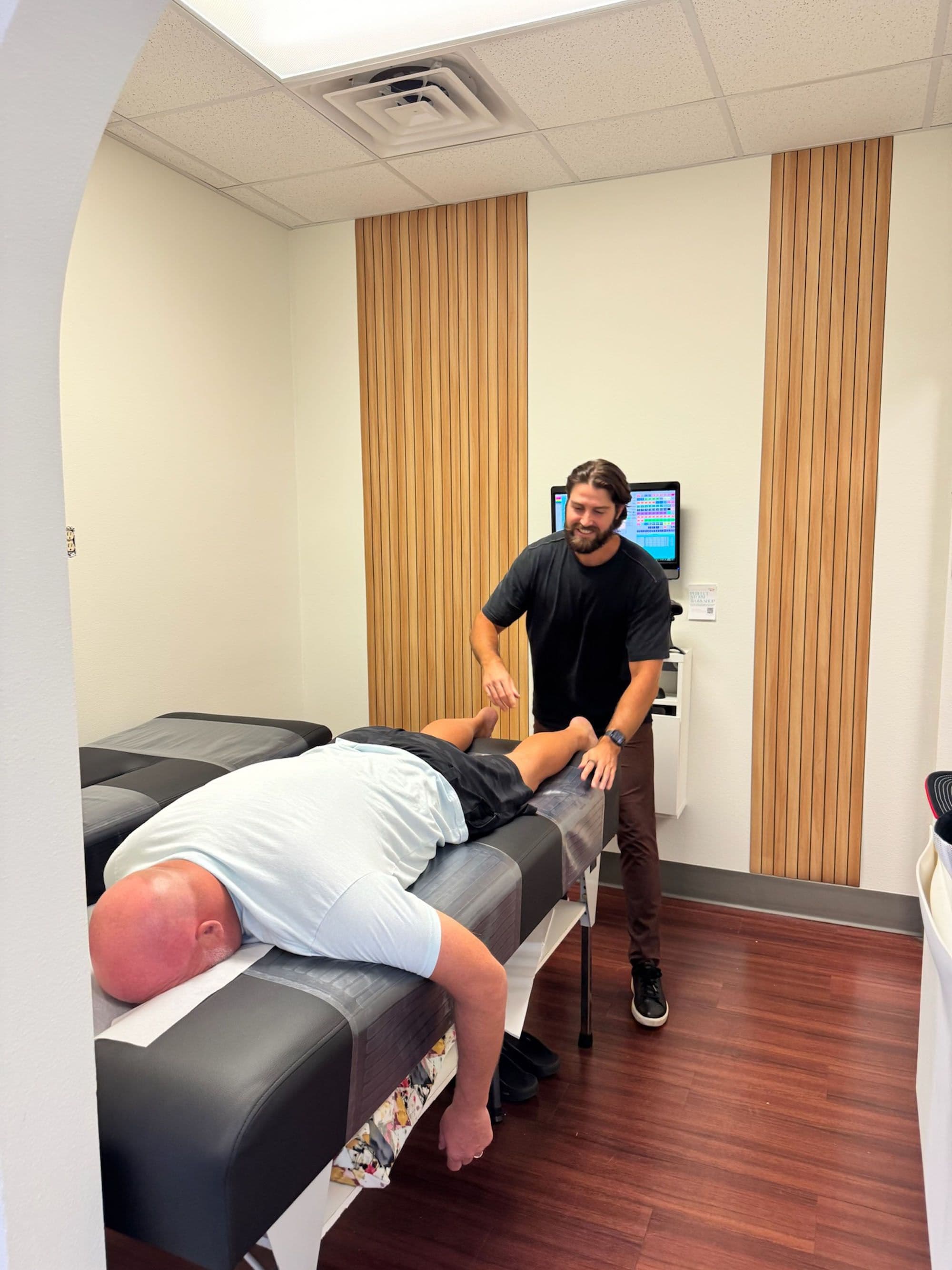
A typical session for plantar fasciitis takes 10 to 15 minutes per foot:
- You lie on a treatment table
- Gel is applied to the bottom of your foot (like ultrasound gel)
- The handpiece moves systematically across the medial heel and origin of the fascia
- The sensation feels like rapid tapping at high pressure — intense but not sharp, roughly 5 or 6 out of 10
- Intensity is adjustable based on your tolerance
After the session the area often feels tender for 24 to 48 hours as the healing response kicks in, and then you feel noticeably better.
A standard course is three to six sessions, spaced about a week apart. Most patients experience some improvement after the first or second session. By the end of the protocol, roughly 60 to 80% report significant improvement — often going from constant daily pain to minor occasional discomfort or full resolution.
Shockwave vs. cortisone
- Cortisone masks pain by suppressing inflammation. Shockwave heals the underlying tissue.
- Cortisone usually provides 3 to 6 months of relief, after which pain often returns worse
- Shockwave produces gradual, lasting tissue change that does not wear off
- Cortisone carries real risks: fat pad atrophy, fascia rupture, systemic corticosteroid effects
- Shockwave's main side effects are temporary soreness and occasional mild bruising
Shockwave vs. surgery
A small percentage of patients eventually get offered plantar fascia release, in which the fascia is partially cut to reduce tension. Results are variable, recovery takes months, and long-term outcomes include increased risk of arch collapse. Most patients offered surgery have never tried shockwave — which is striking, because shockwave resolves a significant percentage of cases that would otherwise proceed to the operating room. If your provider is recommending surgery and you have not tried shockwave, get a second opinion first.
Who is a good candidate
The patients who respond best:
- Have had plantar fasciitis at least 3 months (acute cases often resolve with simpler measures)
- Have tried conservative care without lasting relief
- Have pain concentrated at the medial heel or arch
- Do not have a contraindication (active infection, pregnancy, bleeding disorders, certain cardiac conditions)
Age is not a limit. We treat patients from their thirties into their seventies with strong outcomes across that range.
Why we combine it with other modalities
Shockwave works on its own, but it works better as part of a comprehensive plan. We typically pair it with:
- Red light therapy to reduce inflammation and accelerate cellular repair at the mitochondrial level
- Corrective chiropractic addressing the kinetic chain from the lumbar spine to the ankle
- Home rehabilitation exercises targeting calf and intrinsic foot strength
About 70% of our plantar fasciitis patients see meaningful improvement by the third session.
Chronic foot pain is rarely a purely local problem. The foot sits at the bottom of a long kinetic chain — calves, knees, hips, sacrum, lumbar spine. Biomechanical dysfunction anywhere along that chain puts abnormal loads on the plantar fascia. Fixing plantar fasciitis without addressing upstream drivers often leads to relapse 6 to 12 months later.
If you have had heel pain more than a few weeks and standard treatments are not resolving it, shockwave is worth a serious look. See patient case studies for examples of how recovery plays out. Book a complimentary consultation or call (941) 877-1507 to schedule an evaluation with Dr. Logan Swaim.
Conditions We Treat
Plantar Fasciitis
Drug-free plantar fasciitis care combining shockwave therapy, red light therapy, and biomechanical correction — most patients see meaningful improvement within three visits.
Sports Injuries
Targeted chiropractic care, shockwave therapy, and rehab protocols designed to speed recovery and prevent re-injury.
Services Related to This Post
Keep Reading
Related articles
Why Your Plantar Fasciitis Keeps Coming Back (And How to Stop It)
Treated your plantar fasciitis with rest, stretches, orthotics — and it still keeps returning? Here's what's actually going on and how to break the cycle.
Read articleBone-on-Bone? Here's What to Try Before Knee Replacement
A 'bone-on-bone' diagnosis isn't a death sentence for your knee. Here's the non-surgical protocol that's helped many patients delay or avoid knee replacement entirely.
Read articleFrozen Shoulder: Your Real Recovery Options
Frozen shoulder can take 1–3 years to resolve on its own. Here's how to dramatically speed up recovery and avoid the wait.
Read article