
Tech Neck: The Modern Posture Epidemic Nobody's Talking About
The average American spends over four hours a day looking at their phone. Add eight hours of computer work, a commute spent looking down at a dashboard or phone in your lap, and evening TV on the couch — and the modern spine is under constant forward-flexion stress that human anatomy was never designed to handle. We call it tech neck, and it is not a minor inconvenience. It is a structural condition that is reshaping the cervical spines of an entire generation, driving chronic neck pain, tension headaches, upper back pain, and accelerated disc degeneration in people decades younger than we would expect.
The biomechanics of forward head posture
Your head weighs about 10 to 12 pounds when balanced directly over your shoulders. In this neutral position, the cervical spine handles the load efficiently — the vertebrae stack neatly, the muscles engage symmetrically, and the intervertebral discs are loaded evenly.
But for every inch your head shifts forward of your shoulders, the effective load on your cervical spine roughly doubles:
- 1 inch forward — approximately 20 pounds of effective load
- 2 inches forward — approximately 30 pounds
- 3 inches forward — approximately 40 pounds
- 4 inches forward — approximately 50 pounds or more
A 3-inch forward head posture is extremely common in office workers and phone users. That means the muscles, ligaments, and discs of the cervical spine are carrying more than three times the load they were designed for — for hours every single day.
The muscles that compensate are the upper trapezius, levator scapulae, and suboccipital group. These are the muscles that feel like concrete at the end of a workday. That chronic tightness is not random tension. It is your body trying to hold a 40-pound bowling ball that has drifted three inches off its base.
What happens to the spine over time
Tech neck does not just cause muscle soreness. Left unaddressed, it produces measurable structural changes in the cervical spine:
- Loss of cervical lordosis — the natural C-shaped curve of the neck flattens. In severe cases, it reverses entirely (cervical kyphosis). This curve exists for a reason — it distributes load, absorbs shock, and protects the spinal cord. Losing it accelerates every other problem on this list.
- Disc degeneration — uneven loading compresses the front of the cervical discs while stretching the back. Over years, this leads to disc bulging, thinning, and eventual herniation.
- Facet joint arthritis — the small joints that guide spinal motion become overloaded and develop arthritic changes.
- Reduced spinal canal space — as the curve flattens and discs degenerate, the canal that houses the spinal cord narrows. In advanced cases, this can contribute to cervical stenosis.
- Thoracic rounding — the upper back follows the neck forward, creating a permanent hunch that compresses the chest cavity and reduces lung capacity.
These changes develop slowly — over years, not weeks. By the time the pain arrives, the structural damage is often well established. That is why we see patients in their 30s with cervical spine imaging that looks like it belongs to someone two decades older.
Symptoms most people do not connect to their posture
Chronic neck pain is the obvious symptom. But tech neck drives several other complaints that patients rarely connect to their posture:
- Tension headaches — originating at the base of the skull where the suboccipital muscles are chronically overloaded
- Jaw pain and TMJ dysfunction — the muscles that control the jaw attach to the upper cervical spine, and their tension follows cervical misalignment
- Shoulder pain — the upper trapezius and levator scapulae become chronically tight, referring pain into the shoulders and upper arms
- Numbness or tingling in the hands — cervical disc compression from forward head posture can irritate nerve roots that feed the arms and hands
- Fatigue — a compressed thoracic cage reduces lung volume, meaning every breath is slightly less efficient
- Brain fog and poor concentration — reduced blood flow through a kinked vertebral artery (which runs through the cervical vertebrae) may contribute to cognitive symptoms
If your neck feels like it never fully relaxes, even on vacation, the problem is not stress. It is structure. Your cervical spine has adapted to a position it was never meant to hold.
Why stretching alone does not fix it
Stretching the neck and shoulders provides temporary relief — and we recommend it as part of a daily routine. But stretching alone cannot reverse structural changes that have developed over years:
- Stretching does not restore a lost cervical curve
- Stretching does not rehydrate a compressed disc
- Stretching does not correct vertebral misalignment
- Stretching does not retrain the deep cervical flexors that have atrophied from years of disuse
The muscles that stretching targets (upper trapezius, scalenes, suboccipitals) are compensating for a structural problem. Release them without correcting the structure, and they tighten right back up — usually within hours. This is why massage, foam rolling, and stretching produce relief that never lasts.
Our corrective approach
At The Roots Health Centers in Lakewood Ranch, tech neck patients receive a structured corrective plan that addresses the structure, not just the symptoms:
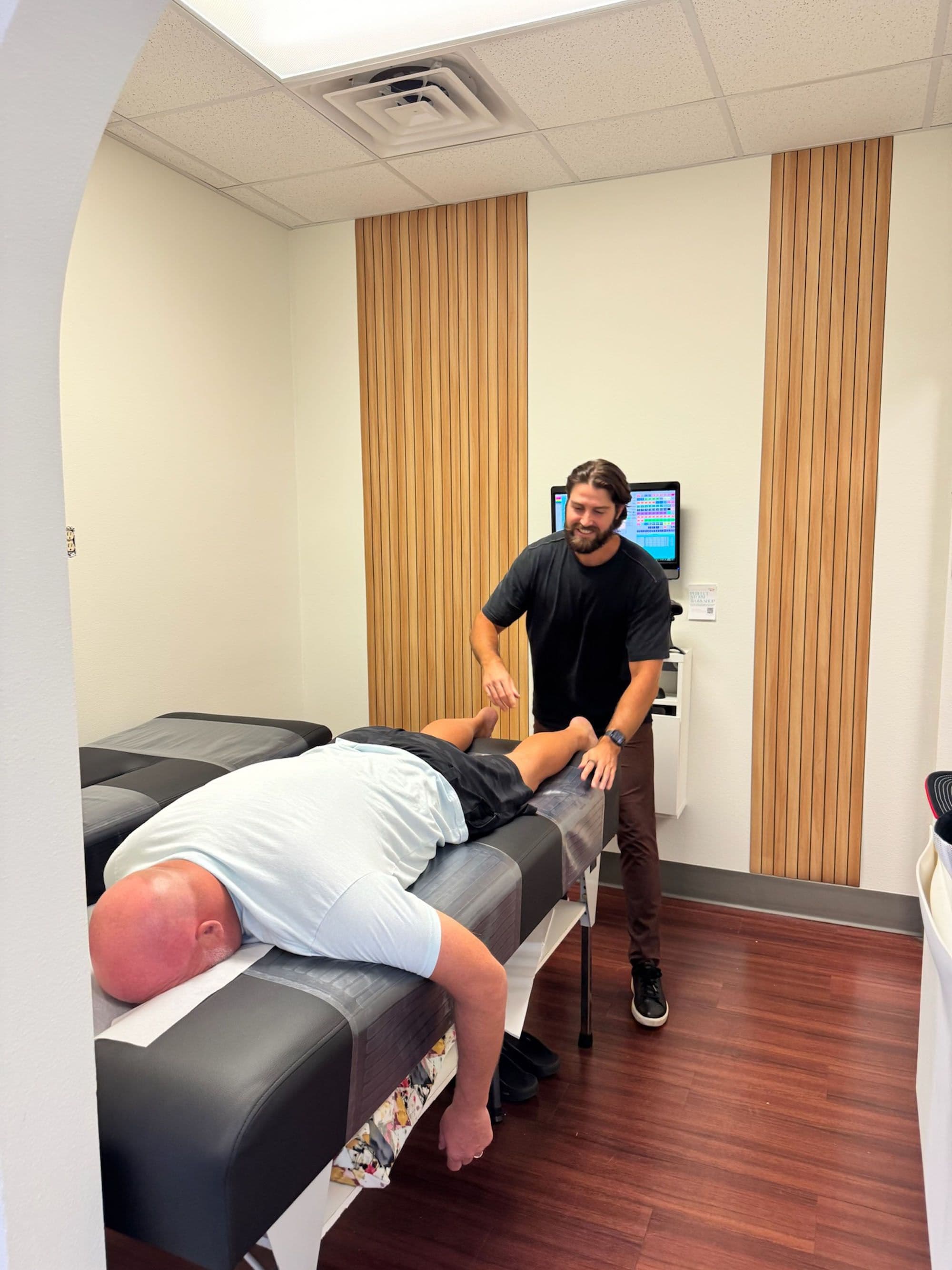
- Corrective chiropractic using the Torque Release Technique — gentle, precise adjustments that progressively restore cervical alignment and encourage the return of the natural lordotic curve. No twisting, no cracking, no manual thrusting.
- CLA INSiGHT nerve scans — baseline measurements of muscle tension patterns (surface EMG), autonomic nervous system function (thermal scanning), and stress adaptability (heart rate variability). These are re-scanned periodically so progress is visible and measurable.
- Postural rehabilitation exercises — specifically targeting the deep cervical flexors (the muscles that hold your head over your shoulders from the front). These muscles are almost universally weak in tech neck patients. Strengthening them is what makes the correction hold long-term.
- Red light therapy — reducing the chronic inflammation that accumulates in overstressed cervical tissues. When muscles, ligaments, and discs have been under abnormal load for years, the inflammatory environment needs to be resolved before structural correction can fully take hold.
- Ergonomic guidance — monitor height, desk setup, phone habits, and sleep position recommendations tailored to your specific postural pattern. Small daily changes compound over months.
Dr. Logan Swaim builds each care plan based on objective findings — not guesswork. If your cervical curve has flattened, the plan focuses on restoring it. If your discs are showing early degeneration, spinal decompression may be layered in.
What recovery looks like
Tech neck correction is not instant — it took years to develop, and it takes weeks to months to reverse. But the progression is consistent and measurable:
- Weeks 1-3 — muscle tension begins to decrease, headache frequency drops, sleep often improves as nighttime neck tension eases
- Weeks 4-8 — range of motion opens up, the chronic "tight" feeling in the upper back and shoulders starts to resolve, re-scan numbers improve
- Weeks 8-16 — structural correction consolidates. Patients who started with flattened cervical curves typically show measurable improvement on follow-up imaging.
The changes hold when supported by the postural exercises and ergonomic adjustments. Patients who maintain their home program and transition to a wellness schedule of one to two visits per month rarely slide back.
Who is most at risk
Tech neck affects nearly everyone who uses screens regularly, but certain groups are hit hardest:
- Office workers — 8+ hours of seated computer work with the head forward
- Teenagers and young adults — phone use begins in childhood, and developing spines are more susceptible to reshaping under sustained load
- Remote workers — home office setups are often worse than corporate ergonomic stations
- Healthcare and dental professionals — sustained forward-head posture during patient care
- Gamers — prolonged screen time in poor posture, often starting young
We are already seeing cervical curve loss in patients in their twenties. The earlier it is caught, the easier and faster the correction.
If your neck feels constantly tight, you wake up stiff, you get tension headaches, or you know your posture is getting worse year by year — get evaluated before the structural changes become harder to reverse. A CLA INSiGHT scan and cervical evaluation takes about thirty minutes and will tell you exactly where you stand. See patient case studies for examples of postural correction outcomes. Book your $49 new patient special with Dr. Logan Swaim or call (941) 877-1507.