
pain-musculoskeletal

TMJ Pain: Why the Dentist Isn't Always the Right First Stop
The Roots Health CentersFebruary 18, 20267 min read

You have jaw pain. Maybe clicking or grinding. Maybe a dull ache along your jawline that shows up every afternoon. Maybe your jaw locks when you open wide to take a bite of a burger. Maybe you grind your teeth at night and wake up with your jaw already tight. You see your dentist. They evaluate the joint, check for grinding wear, and offer a night guard. Maybe Botox injections into the masseter. Maybe a referral to an oral surgeon to discuss procedures on the joint itself. The night guard helps a little. Or it does not help at all. The Botox lasts three months and then you are back where you started. Here is the part you have almost certainly not been told: the majority of TMJ dysfunction does not start in the jaw. It starts in the upper cervical spine. And until that piece is addressed, the jaw will keep doing what it is doing no matter how many night guards you wear or how much Botox you get.

What TMJ dysfunction actually is

The temporomandibular joint (TMJ) is the joint where your lower jaw (mandible) connects to your skull, just in front of your ears. It is one of the most complex joints in your body — a hinge joint that also slides forward and back, surrounded by muscles, ligaments, and a small disc that cushions the movement. It moves every time you talk, chew, swallow, yawn, or clench your teeth — thousands of times a day.

TMJ dysfunction is an umbrella term for problems with this system. Common symptoms:

  • Jaw pain, especially on one side
  • Clicking, popping, or grinding sounds during movement
  • Jaw locking, catching, or deviating to one side when opening
  • Pain that refers into the ear, temple, cheek, or the back of the head
  • Headaches, particularly at the temples or along the jawline
  • Neck and shoulder tension that seems connected to the jaw
  • Teeth grinding (bruxism) and the wear patterns that come with it
  • Tinnitus or ear fullness
  • Tightness in the muscles of mastication (masseter, temporalis, pterygoids)

These symptoms can be mild and occasional, or debilitating and constant. For many patients, TMJ dysfunction is a years-long problem that no single provider has been able to fully resolve.

The upper cervical spine connection

Here is the anatomical fact that most TMJ treatment plans overlook. The muscles that control the jaw — masseter, temporalis, medial and lateral pterygoid — do not exist in isolation. They are part of a biomechanical and neurological system that is intimately connected to the upper cervical spine (C1 and C2 in particular).

Specifically:

  • Muscles of mastication attach to the skull, which is stacked on the upper cervical vertebrae. Alignment problems at C1 and C2 tilt the skull, changing the pull of every jaw muscle.
  • The trigeminal nerve, which innervates the jaw muscles and provides facial sensation, has a significant convergence with nerve input from the upper cervical spine in the trigeminocervical nucleus. Upper cervical dysfunction can produce jaw symptoms directly through this neurological convergence.
  • The digastric, suprahyoid, and infrahyoid muscles link the jaw, hyoid bone, and cervical spine into a single functional chain. Any asymmetry in the chain distributes into the jaw.
  • Postural head position — the forward head posture common in tech users, desk workers, and anyone who spends hours on a phone — pulls the mandible posteriorly and changes TMJ mechanics.

When the upper cervical spine is misaligned (from whiplash, sustained poor posture, an old fall, or birth trauma), the skull tilts. The jaw muscles on one side stay chronically tighter than the other. The jaw tracks off-center. Clicking, grinding, and pain follow — in the jaw — but the source is in the neck.

Why night guards do not fix it

Night guards are the most common initial treatment for TMJ dysfunction. They work by creating a flat, even surface for the teeth to contact during sleep — reducing the wear patterns from grinding and sometimes relaxing the jaw muscles slightly. They have a legitimate role in certain cases.

What night guards do not do:

  • Address the upper cervical alignment driving the asymmetry
  • Reduce the chronic muscle tension patterns in the jaw
  • Fix the postural patterns contributing to the dysfunction
  • Restore normal TMJ mechanics

Patients who wear night guards often describe the same experience: the grinding reduces, but the jaw pain, clicking, and headaches continue. That is because the night guard treats one downstream symptom (grinding wear) without addressing the upstream cause (cervical misalignment driving the whole pattern).

If your TMJ pain is not getting better with a night guard, Botox, or dental interventions, your problem is probably not actually in the joint. It is in the neck. And nobody has looked there yet.

Why Botox is a short-term fix

Botox injections into the masseter and temporalis muscles can dramatically reduce muscle tone and jaw pain — for about three to four months, until the Botox wears off. Then the muscles regain full function and the problem returns, because the underlying driver of the muscle hypertonicity was never addressed.

There is a legitimate role for Botox in severe cases where extreme muscle hypertonicity is creating acute symptoms. But as a long-term strategy, it is a maintenance intervention, not a fix. Every few months, you come back for another round. The underlying cervical and postural issues continue to drive the pattern underneath.

How our approach is different

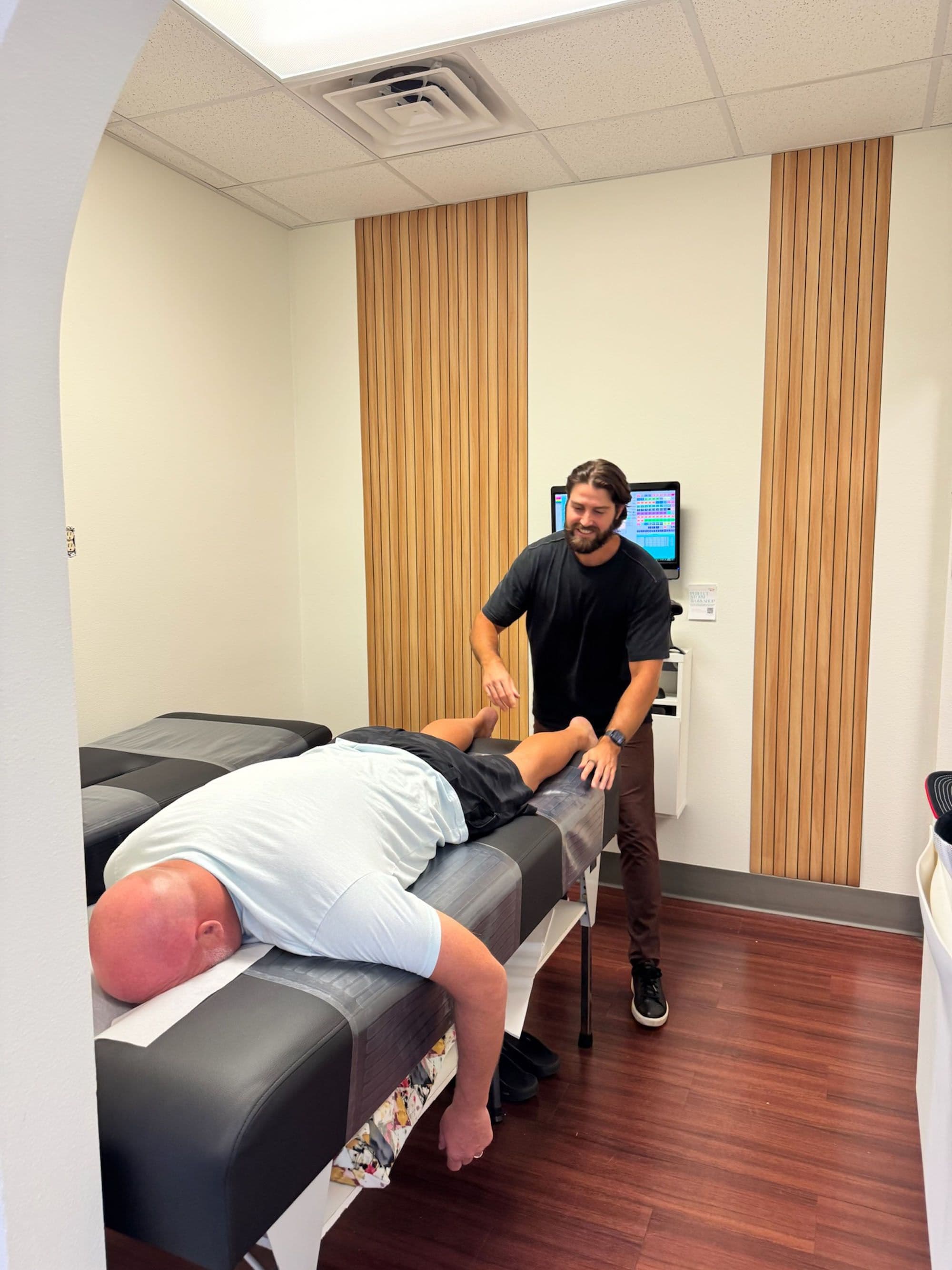
At The Roots Health Centers in Lakewood Ranch, our TMJ protocol starts with the upper cervical spine. Dr. Logan Swaim evaluates the entire cervical region, the cranial base, and the postural patterns driving the dysfunction before any treatment is applied to the jaw itself.

The evaluation includes:

  • A detailed history — including any history of whiplash, concussion, head trauma, orthodontia, or jaw surgery
  • Palpation of the TMJ, muscles of mastication, cervical spine, and cranial base
  • Range-of-motion testing of the jaw and cervical spine
  • Orthopedic testing for cervical instability, thoracic outlet involvement, and cranial dysfunction
  • CLA INSiGHT nerve scans — measuring muscle tension patterns along the cervical spine and autonomic nervous system function
  • Digital x-rays when indicated — to see cervical alignment and any structural considerations

Once we understand what is happening at the cervical level, we can address the jaw effectively. Without that upstream correction, jaw-focused care tends to produce temporary relief that does not hold.

The treatment protocol

Our TMJ protocol typically combines:

  • Upper cervical corrective chiropractic — using Torque Release Technique, a gentle, instrument-assisted method that delivers precise low-force impulses. No twisting. No cracking. No manual thrusting. This addresses the alignment patterns at C1 and C2 that drive the asymmetric jaw mechanics.
  • Soft tissue release of the jaw muscles — targeted work on the masseter, temporalis, and pterygoid muscles. This breaks chronic tension patterns and allows the jaw to find a more neutral resting position.
  • Red light therapy — reduces chronic inflammation in the jaw muscles and TMJ capsule, accelerates tissue repair, and supports cellular-level healing in the surrounding fascia.
  • Postural rehabilitation — specifically targeting the deep cervical flexors and addressing the forward-head posture that often feeds TMJ dysfunction. See our related article on tech neck for more on this.
  • Jaw mobility and coordination exercises — helping the jaw learn symmetric, functional movement patterns after years of compensating.

Most TMJ patients see meaningful improvement within three to four weeks. Full resolution of chronic patterns often takes 8 to 12 weeks — faster for patients whose TMJ dysfunction developed recently, slower for patients with a decade or more of accumulated pattern.

When dental care is still essential

We do not position this as a "chiropractic instead of dental care" conversation. Good dental care matters. If your teeth alignment is causing bite issues, see your dentist or orthodontist. If you have active tooth decay or gum disease, those need dental treatment. If your dentist identifies a structural problem with a tooth that is contributing to grinding, that needs addressing.

What we are saying is that when dental interventions alone have not resolved your TMJ symptoms, the upper cervical spine is the next place to look. We coordinate with dentists and oral surgeons when cases require it. Our work complements good dental care, not substitutes for it.

Who responds best

The TMJ patients who see the strongest outcomes typically have:

  • A history of whiplash, concussion, or head trauma (even years ago)
  • Concurrent neck pain or upper trapezius tightness
  • Headaches or migraines alongside the jaw symptoms
  • Unilateral jaw dysfunction (one side worse than the other)
  • TMJ pain that has not responded to night guards or dental interventions
  • A desk-based job or heavy phone use driving forward-head posture

Even patients who have already had oral surgery, extensive orthodontic work, or years of Botox injections often respond well when the upper cervical component is finally addressed.

If your TMJ pain has not been responding to dental treatment, or if you have noticed a connection between your neck and your jaw symptoms, stop chasing the jaw in isolation. The upper cervical spine is where the problem usually lives. Book your $49 new patient special with Dr. Logan Swaim for a comprehensive cervical and TMJ evaluation, or call (941) 877-1507 to schedule.

Services Related to This Post

Have a Health Question?

Call us or book a consultation. We'd love to help.