

Cervicogenic Headaches: When a Headache Is Actually a Neck Problem
If you've been told your headaches are "just tension" or "just migraines" and the usual advice hasn't helped, there's a third possibility worth ruling out: a cervicogenic headache, meaning a headache that actually starts in your neck rather than your head. It's one of the more commonly missed headache patterns we see at The Roots Health Centers, in part because it can feel a lot like a tension headache or even a migraine, but it responds to different things. Here's how to tell the difference, what's actually happening in your neck when this type of headache shows up, and how chiropractic care may help.
What Is a Cervicogenic Headache?
A cervicogenic headache is a headache caused by a problem in the cervical spine — the neck — rather than starting inside the head itself. The joints, discs, and muscles of your upper neck share nerve pathways with the head and face through a structure called the trigeminocervical nucleus, which is the biological reason irritation in your neck can be felt as pain behind your eye, across your forehead, or at the base of your skull. Unlike a tension headache or migraine, which involve processes within the brain and its surrounding structures, a cervicogenic headache is fundamentally a referred pain pattern — the neck is the source, and the head is simply where you feel it.
Telling It Apart From a Tension Headache or Migraine
A few patterns tend to point toward the neck as the source, and distinguishing this from a tension headache or migraine matters because the right approach is different for each.
It usually starts on one side. Cervicogenic headaches are typically one-sided and tend to stay on the same side each time, unlike migraines, which can switch sides.
It starts at the base of the skull and spreads forward. Many people describe the pain beginning low, near where the neck meets the skull, then radiating up and over toward the forehead or behind one eye.
Neck movement or position makes it worse. Turning your head, holding a position too long, or pressure on certain points in the upper neck can reproduce or intensify the headache — something migraines and typical tension headaches don't usually do.
Your neck feels stiff or restricted, even away from the headache. A limited range of motion in the neck often accompanies this type more than other headache types.
None of these signs alone confirms a cervicogenic headache — that's why a proper evaluation matters more than trying to self-diagnose from a checklist.
What's Actually Causing It
Cervicogenic headaches usually trace back to irritation or restricted movement in the top three joints of the cervical spine, just below the skull. That irritation can come from poor posture held for long stretches, whiplash from a car accident, a previous neck injury, or simply years of restricted movement that built up gradually rather than from one specific event. Chronic neck pain and cervicogenic headaches often travel together for exactly this reason — when the upper neck isn't moving well, both symptoms tend to show up.
Cervicogenic Headache vs. Occipital Neuralgia
Cervicogenic headaches are sometimes confused with occipital neuralgia, another condition that causes pain at the base of the skull. The difference comes down to character: occipital neuralgia tends to feel sharp, shooting, or shock-like along a specific nerve path, while a cervicogenic headache is usually a duller, more constant ache that builds and radiates. Because the two can overlap and even occur together, an evaluation that looks at both the joints and the nerves of the upper neck is more useful than trying to tell them apart on your own.
Common Triggers We See in Lakewood Ranch Patients
A few patterns come up often in our office: hours spent looking down at a phone or laptop, a desk setup that puts the monitor too low or too far away, side-sleeping with a pillow that doesn't support the neck's natural curve, and the after-effects of a car accident that never fully resolved. None of these are unique to any one job or lifestyle — they add up gradually, which is part of why the pattern can take a while to connect back to the neck in the first place.
When to Get It Checked
A headache that's new, that's the worst you've ever had, or that comes with fever, vision changes, weakness, or confusion needs prompt medical attention rather than a wait-and-see approach — those aren't cervicogenic headache patterns and deserve to be evaluated right away. For a headache that's been building gradually, keeps returning in the same pattern, and seems connected to your neck, an evaluation focused on how your cervical spine is actually moving is a reasonable next step.
How Chiropractic Care May Help
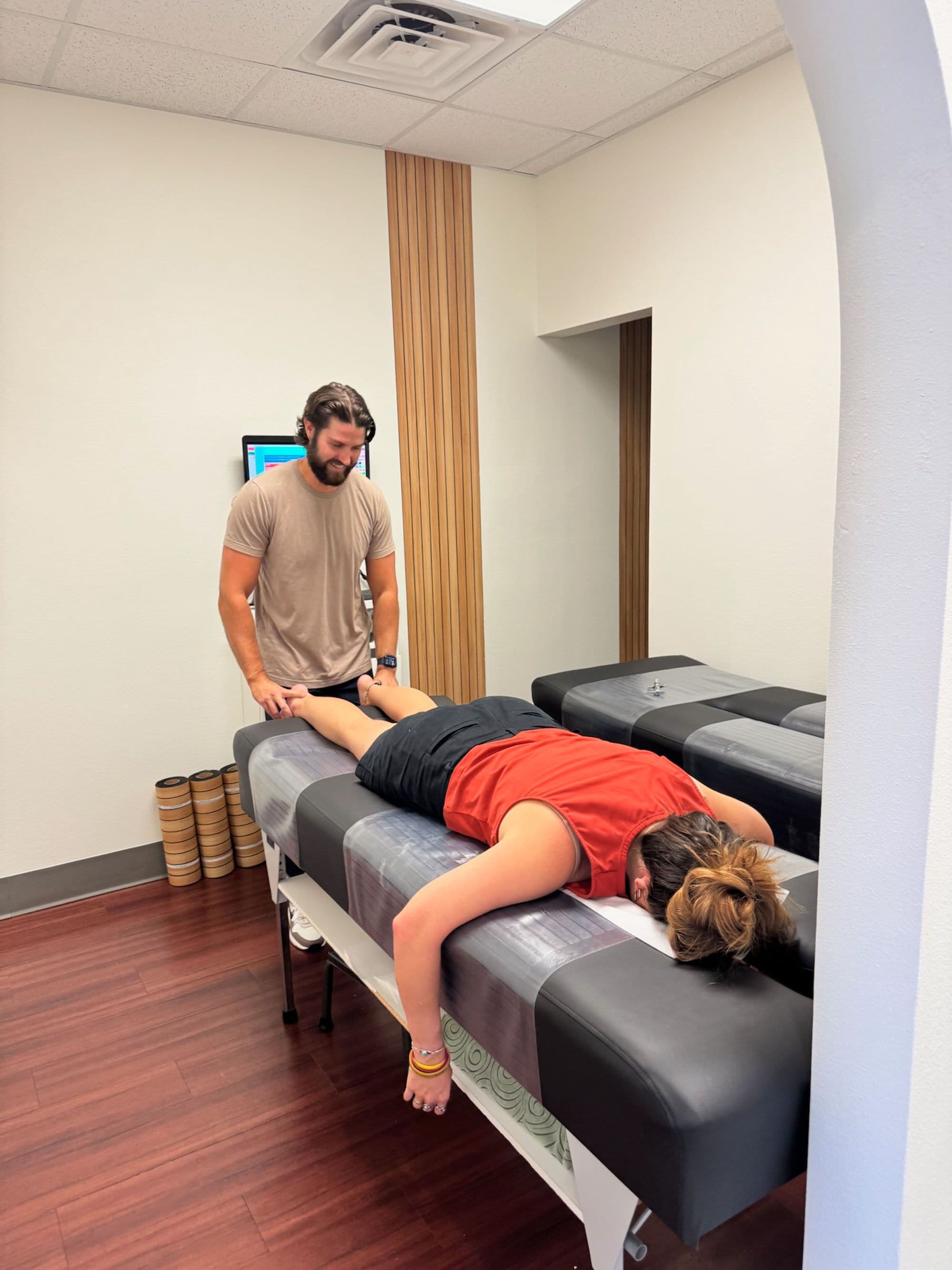
At The Roots Health Centers, we start with a consultation and a full neurological evaluation to understand what's actually driving your headaches, plus any necessary X-rays when they're clinically indicated. If your evaluation points to restricted movement in your upper neck, we use the Torque Release Technique — a gentle, low-force adjustment method — to help address those areas. We won't promise a specific number of visits or a headache-free timeline at your first visit; each person and case is different, so our chiropractic care approach is personalized based on what your evaluation actually shows.
Supporting a Healthier Neck Day to Day
A few habits help beyond the clinic: raising your monitor and phone closer to eye level rather than looking down for hours, taking brief movement breaks during long desk sessions, and choosing a pillow that keeps your neck in a neutral position overnight rather than bent sharply to one side. None of these replace an evaluation if a pattern is already established, but they can reduce how often an irritated neck gets the chance to flare.
Frequently Asked Questions
What does a cervicogenic headache feel like? It often starts as a dull ache at the base of the skull on one side and spreads forward toward the forehead or behind the eye, and tends to get worse with certain neck movements or positions.
Can neck problems really cause headaches? Yes — the nerves in your upper neck share pathways with the head and face, so irritation or restricted movement there can be felt as head pain even though the neck is where the problem actually is.
How is a cervicogenic headache different from a migraine? Migraines typically involve additional symptoms like nausea, light sensitivity, or visual changes, and don't usually change with neck position. Cervicogenic headaches are more likely to be one-sided, tied to neck movement, and accompanied by neck stiffness.
Can chiropractic care help with cervicogenic headaches? It may, particularly when restricted movement in the upper neck is part of the picture. We start with a full neurological evaluation to understand what's actually happening before recommending anything.
How long do cervicogenic headaches last? That varies from person to person and depends on what's driving it, so there's no single timeline that fits everyone. An evaluation is a more reliable way to understand your own pattern than trying to estimate it in advance.
If your headaches keep starting at the base of your skull or seem tied to your neck, it's worth having that connection actually looked at. Book a complimentary consultation at The Roots Health Centers in Lakewood Ranch — meet the team, tour the clinic, and get honest answers about what's going on. No commitment to start care.
The Roots Health Centers, 8209 Natures Way, Unit 115, Lakewood Ranch, FL 34202. (941) 877-1507.
Conditions We Treat

Services Related to This Post
Keep Reading
Related articles
Tension Headaches: Why They Keep Coming Back and How to Find Relief
That tight band of pressure around your head has a source, and it's often the neck. Here's why tension headaches recur and how to find relief beyond reaching for pills.
Read articleMigraine vs. Tension Headache: How to Tell the Difference (and What Helps)
Migraines and tension headaches can feel similar but come from different mechanisms — and respond to different approaches. Here's how to tell them apart.
Read articleOccipital Neuralgia: Headaches at the Base of the Skull
That sharp, electric pain radiating from the base of your skull could be occipital neuralgia — not just another headache. Here's what's actually happening and what may help.
Read article